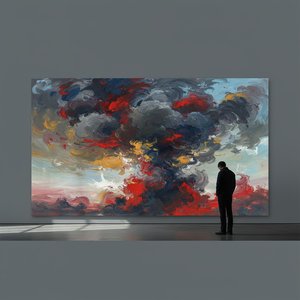
1941. Oil On Canvas, 30.0 x 32.0 cm.

§ 1目录数据

- 30.0 x 32.0 cm


§ 2摘要
藏品详情
Discover Jackson Pollock's 'Circle' (1941), a seminal Abstract Expressionist work bursting with color and dynamic animal figures. Explore its Surrealist influences & lasting impact on modern art.
 展开全文
展开全文
§ 3赏析
Jackson Pollock’s Circle: A Dance of Color and Chaos
Jackson Pollock's “Circle,” painted in 1941, isn’t merely a depiction of a circle; it’s an embodiment of the burgeoning Abstract Expressionist movement and a profound exploration of subconscious creation. Measuring just 30 x 32 centimeters, this oil-on-canvas work feels surprisingly intimate despite its vibrant energy. It represents Pollock's early experimentation with form, a pivotal moment as he wrestled with new techniques and sought to capture the raw emotion of his inner world – a world increasingly influenced by the avant-garde currents swirling around him. The painting immediately draws the eye to the central red circle, a bold assertion of shape amidst a dynamic field of color: yellows, blues, greens, and oranges collide in a seemingly random yet meticulously orchestrated dance. This isn’t a static image; it's an invitation to lose yourself within its layers of texture and hue.Echoes of Surrealism and the Birth of Action Painting
Pollock’s “Circle” stands as a testament to his engagement with the artistic landscape of the early 1940s, particularly the influence of Surrealist artists like André Masson and Max Ernst. These pioneers championed spontaneous creation, tapping into the subconscious mind as a primary source of inspiration. Pollock adopted this approach, abandoning traditional representational techniques in favor of methods that prioritized instinct and gesture. The swirling brushstrokes, the drips and splatters – these aren’t accidental; they are deliberate marks, imbued with the artist's physical presence and emotional state. This technique, often referred to as “drip painting” or “action painting,” became a hallmark of Pollock’s style and fundamentally altered the course of 20th-century art. It was a rejection of the easel and brush, embracing instead the entire canvas as a battleground for color and movement.A Composition of Symbolic Forms
Beyond its purely abstract qualities, “Circle” is populated with carefully chosen symbolic figures – birds and fish scattered throughout the composition. These aren’t simply decorative elements; they seem to engage in an abstracted interaction, creating a sense of dynamic tension within the painting. Some art historians interpret these animal forms as representing primal instincts or perhaps even echoes of Pollock's early fascination with Native American culture and their connection to nature. The circle itself can be seen as a symbol of wholeness, unity, or perhaps even the cyclical nature of life and death – themes frequently explored in Surrealist art. The arrangement isn’t logical; it’s driven by feeling, mirroring the artist's own internal landscape.Abstract Expressionism: A New American Voice
“Circle” is inextricably linked to the rise of Abstract Expressionism, a movement that emerged in the United States following World War II and quickly gained international recognition. Artists like Pollock, Mark Rothko, Willem de Kooning, and others sought to express profound emotions through non-representational forms, rejecting European artistic traditions in favor of a distinctly American style. This period was characterized by a radical shift in artistic priorities – from depicting the external world to exploring the inner self. “Circle” exemplifies this ethos, capturing the raw energy and emotional intensity that defined Abstract Expressionism’s rebellious spirit. It's important to note that the term "abstract expressionism" itself was coined in 1929 by Alfred Barr at MoMA, initially applied to works by Kandinsky, but it truly took hold in the post-war era.A Legacy of Innovation
Pollock’s “Circle” isn't just a beautiful painting; it’s a foundational work that paved the way for countless artists who followed. Its influence can be seen in subsequent movements like Tachisme and Neo-expressionism, demonstrating its enduring relevance to contemporary art. Reproductions of this piece offer a remarkable opportunity to experience Pollock’s revolutionary approach firsthand – to feel the energy of his brushstrokes, to lose yourself in the vibrant colors, and to contemplate the profound questions he posed about the nature of creativity and human emotion. AllPaintingsStore's hand-painted reproductions capture not only the visual impact but also the spirit of this iconic work, allowing you to bring a piece of art history into your own space.常见问题与解答
杰克逊·波洛克 (Jié K逊·Bōluòkè) 的《Circle》 是如何将 Abstract Expressionism 与艺术家的祖籍国联系在一起的?
《Circle》由出生于 美国 的 杰克逊·波洛克 (Jié K逊·Bōluòkè) 在 Abstract Expressionism 运动背景下创作而成。艺术家的原籍地使这部作品与 美国 艺术家所实践的 Abstract Expressionism 风格紧密相连。
在哪里可以购买到 杰克逊·波洛克 (Jié K逊·Bōluòkè) 的《Circle》 的数字图像?
您可以在 高分辨率数字图像 页面直接购买 “Circle” 的 高分辨率数字图像下载。
杰克逊·波洛克 (Jié K逊·Bōluòkè) 的《Circle》创作于哪个时期?
“Circle”创作于Modern时期。


 切换至版画销售渠道


 对于任何边长超过 105 厘米(约 41 英寸)的艺术品或复制品,画框将以拆解后的组件形式发货。此方法可确保安全送达并防止运输过程中的损坏。