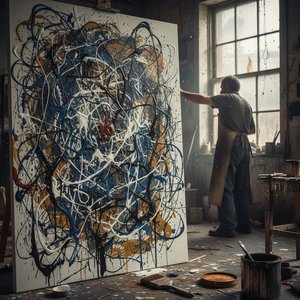
Acrylic On Canvas.

§ 1目录数据

§ 2摘要
藏品详情
Explore Jackson Pollock’s ‘Greetings’! A dynamic drip painting showcasing abstract figures & warm tones in an Expressionist style. Discover this unique mixed-media artwork's energy and layered texture.
 展开全文
展开全文
§ 3赏析
Greetings: An Exploration of Pollock’s Expressionist Vision
Paul Jackson Pollock's “Greetings” stands as a testament to the radical spirit of Abstract Expressionism, encapsulating the movement’s core tenets within a deceptively simple composition. This artwork, created sometime in the mid-1940s—the zenith of Pollock’s groundbreaking drip technique—immediately captivates with its dynamic interplay of color and form, inviting viewers into a realm where visual sensation transcends representational accuracy.
- Subject Matter: The painting depicts stylized human figures engaged in movement, albeit abstracted to the point of near anonymity. These forms swirl and intertwine across the canvas, conveying an impression of restless energy and perhaps hinting at psychological turbulence—themes prevalent throughout Pollock’s oeuvre.
- Style & Technique: Pollock's signature method – drip painting – dominates this piece. He meticulously applied paint onto a horizontal surface laid on the floor, allowing gravity to guide drips and splatters from sticks or cans directly onto the canvas. This process yielded an uneven, textured surface achieved through layering paint and incorporating collage elements—a deliberate departure from traditional painting conventions.
- Color Palette & Composition: The artwork’s color scheme is dominated by warm hues – browns, reds, and yellows – punctuated by darker accents that contribute to the overall mood. The composition is deliberately unbalanced, emphasizing horizontal movement while simultaneously disrupting visual stability. Lines are loose and gestural, creating a sense of spontaneity and mirroring the artist's emotional state.
- Historical Context: “Greetings” emerged during a period of profound artistic experimentation following World War II. Pollock’s work aligns with the broader Expressionist impulse to convey emotion directly—a reaction against formalism and a celebration of subjective experience. It reflects the influence of Surrealism, particularly its exploration of unconsciousness and dreamlike imagery.
- Symbolic Significance: The distorted figures and swirling lines within “Greetings” are laden with symbolic resonance. They represent not merely physical movement but also transformation—a visual metaphor for confronting inner turmoil and embracing change. Pollock’s intention was to bypass rational thought, tapping into primal instincts and conveying feelings beyond verbal articulation.
The painting's signature in the lower left corner – “Greetings Lee and Johnson” – serves as a subtle reminder of its provenance and underscores the collaborative spirit inherent in artistic creation. This artwork embodies Pollock’s unwavering commitment to pushing boundaries, establishing him as one of the most influential figures in 20th-century art.
常见问题与解答
杰克逊·波洛克 (Jié K逊·Bōluòkè) 的《GREETINGS》 属于哪种艺术流派?
杰克逊·波洛克 (Jié K逊·Bōluòkè) 的《GREETINGS》 所属的艺术流派为 Abstract Expressionism。这一分类将该作品置于相关艺术家及艺术作品的语境之中。
杰克逊·波洛克 (Jié K逊·Bōluòkè) 的《GREETINGS》 使用了怎样的色调?
杰克逊·波洛克 (Jié K逊·Bōluòkè) 的《GREETINGS》 采用了 Dark 色调,这一色调概括了作品整体的色彩特征。
如何将 杰克逊·波洛克 (Jié K逊·Bōluòkè) 的《GREETINGS》 应用于家居装饰中?
针对 杰克逊·波洛克 (Jié K逊·Bōluòkè) 的《GREETINGS》,我们为您提供以下两项建议:用途为 (Accent),适宜空间为 (Living Room)。


 切换至版画销售渠道


 对于任何边长超过 105 厘米(约 41 英寸)的艺术品或复制品,画框将以拆解后的组件形式发货。此方法可确保安全送达并防止运输过程中的损坏。