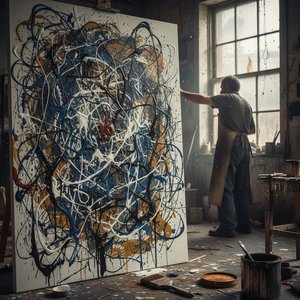
1948. Acrylic On Canvas, 575.0 x 784.0 cm.

§ 1目录数据

- 575.0 x 784.0 cm


§ 2摘要
藏品详情
 展开全文
展开全文
§ 3赏析
Number 23: A Symphony of Chance and Texture
Jackson Pollock’s “Number 23,” completed in 1948, stands as an undeniable cornerstone of Abstract Expressionism—a movement that fundamentally challenged artistic conventions and prioritized emotional expression over representational accuracy. More than just pigment on paper; it's a visceral embodiment of the artist’s process and a profound meditation on spontaneity and control within chaos.
- Composition & Technique: Pollock famously employed the “drip” technique, applying paint directly from cans onto a canvas laid horizontally on the floor. Gravity became an active collaborator, guiding the flow of pigment and resulting in a mesmerizing network of interwoven lines, splatters, and drips. This method deliberately eschewed traditional brushstrokes, favoring chance and improvisation—a radical departure from academic painting.
- Color Palette & Texture: The artwork’s restrained color palette – primarily black and white accented by subtle grey tones – serves to amplify the textural richness of the piece. Thick impasto layers create dramatic contrasts between smooth areas and densely textured surfaces, inviting viewers to explore the tactile qualities of the painting.
- Historical Context & Influence: Created during the height of the postwar artistic fervor in New York City, “Number 23” reflects the broader anxieties and aspirations of its time. Pollock’s work directly responded to the influence of Surrealism and Gestalt psychology, pushing boundaries on how artists could convey emotion and explore subconscious impulses.
- Symbolic Resonance: While devoid of recognizable imagery, "Number 23" speaks volumes about the artist's inner state. The seemingly random arrangement of lines can be interpreted as a visual representation of thought processes—a deliberate attempt to capture the fluidity and dynamism of consciousness. It’s a celebration of process over product.
- Emotional Impact: Viewing “Number 23” evokes feelings of energy, excitement, and perhaps even unease. The painting's dynamic composition compels contemplation, prompting viewers to consider the relationship between order and disorder—a theme that resonates deeply within the human experience.
Its current location at Tate Britain underscores its enduring significance as a pivotal work of modern art. A high-quality reproduction captures not only the visual splendor but also the spirit of innovation that defined Pollock’s groundbreaking approach to painting—a legacy that continues to inspire artists and collectors alike.
常见问题与解答
“Number 23”是如何体现 杰克逊·波洛克 (Jié K逊·Bōluòkè) 的创作主题与艺术风格的?
"Number 23" 是 杰克逊·波洛克 (Jié K逊·Bōluòkè) Abstract Expressionism 时期的代表作,其创作主题涵盖了 pollock’s surrealist roots, western expressionism spirit, chance, improvisation mastery, iconic drip painting style, central to pollock legacy。
"Number 23" 的主导色调是什么?
杰克逊·波洛克 (Jié K逊·Bōluòkè) 的《Number 23》 的主导色调为 Green to Violet Spectrum,这一色调构成了整个色板的基调。
杰克逊·波洛克 (Jié K逊·Bōluòkè) 的作品《Number 23》是否属于公有领域?其原因是什么?
"Number 23" 的版权状态 —— 属于公有领域 —— 其版权已过期 —— 取决于艺术家于 1956 年逝世这一事实。


 切换至版画销售渠道


 对于任何边长超过 105 厘米(约 41 英寸)的艺术品或复制品,画框将以拆解后的组件形式发货。此方法可确保安全送达并防止运输过程中的损坏。