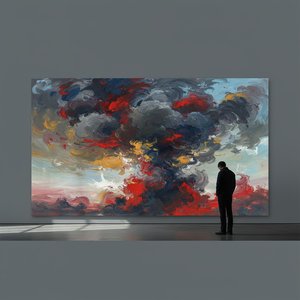
1938. Oil On Board, 51.0 x 76.0 cm.

§ 1目录数据

- 51.0 x 76.0 cm


§ 2摘要
藏品详情
Explore Jackson Pollock’s groundbreaking Abstract Expressionist masterpiece, 'The Flame,' capturing raw energy and vibrant hues in 1938—a mesmerizing testament to spontaneous artistry and a captivating glimpse into the formative years of American modernism.
 展开全文
展开全文
§ 3赏析
Visual Composition and Materiality
The painting The Flame consists of oil on fiberboard, measuring 51 x 76 cm. The surface features a central motif of an incandescent blaze that moves through an amorphous expanse. Dark tones dominate the background, providing a foundation for bursts of crimson, ochre, and cadmium red. Scattered throughout this composition are avian figures. These birds are positioned within the swirling hues, appearing amidst the larger movement of the central element. The application of paint involves thick layers and heavy brushwork that creates a textured surface.
The color palette relies on the contrast between deep, dark pigments and bright yellows and whites. Lines of color intersect across the canvas in a way that suggests motion. While the work contains recognizable shapes like birds and fire, the edges of these forms are often blurred by the surrounding splatters and fluid applications of pigment.
Technique and Artistic Development
Created in 1938, this work reflects an era of experimentation with spontaneous gesture. The technique utilizes a method where paint is poured, dripped, or splashed onto the surface, allowing gravity to influence the resulting patterns. This approach moves away from traditional, meticulous brushstrokes toward a more fluid and automatic process. The physical act of applying the medium creates interwoven lines and textures that capture energy in a tangible form.
The method shows an early interest in the movement and transformation found in fire. It incorporates elements of rhythmic composition influenced by Regionalist aesthetics and the powerful imagery of Mexican muralism. The use of specific colors, such as burnt umber alongside bright reds, indicates an engagement with the visual language of Native American art. This period of work precedes the more famous all-over drip paintings, representing a transition toward a freer, more expressive style of abstraction.
Symbolic Elements and Context
The central theme of the painting centers on fire as a metaphor for creative energy and spiritual rebirth. The flames engulfing the scattered birds suggest a state of transformation. These avian figures represent instinct and freedom, placed strategically to interact with the surrounding heat. The dark, brooding colors of the background contribute to a sense of tension and unrestrained potential.
Historically, the work emerged during a time of significant artistic shifts, including the influence of Surrealist principles and the concept of automatism. This involves channeling the subconscious into the creative process. The painting functions as a record of movement, where the interplay of light and dark tones mirrors the primal force of an actual blaze. Through its use of color and form, the work communicates a sense of internal change and the raw power of natural elements.
常见问题与解答
建议将“The Flame”打印成多大的尺寸?
建议为 杰克逊·波洛克 (Jié K逊·Bōluòkè) 的《The Flame》 制作 Small 的复制品。尺寸可以在保持比例不变的情况下进行调整。
杰克逊·波洛克 (Jié K逊·Bōluòkè) 的《The Flame》 是油画、素描还是版画?
杰克逊·波洛克 (Jié K逊·Bōluòkè) 的《The Flame》 被归类为 WallArt。该类别描述了原作的艺术形式。
是否有关于 杰克逊·波洛克 (Jié K逊·Bōluòkè) 的《The Flame》 的导览页?
针对 杰克逊·波洛克 (Jié K逊·Bōluòkè) 的《The Flame》,我们提供了一个 指南 页面:这是一份可打印的艺术品资料页,专为学生及课堂教学使用而设计。


 切换至版画销售渠道


 对于任何边长超过 105 厘米(约 41 英寸)的艺术品或复制品,画框将以拆解后的组件形式发货。此方法可确保安全送达并防止运输过程中的损坏。