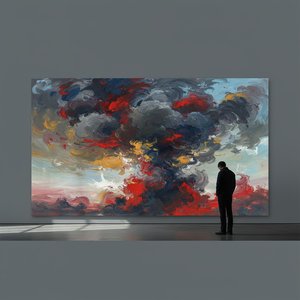
1946. Acrylic.

§ 1目录数据


§ 2摘要
藏品详情
Experience Jackson Pollock's groundbreaking drip painting technique in 'The Key,' a vibrant abstract expressionist masterpiece capturing raw emotion and dynamic movement from 1946 – explore this iconic artwork today.
 展开全文
展开全文
§ 3赏析
A Dance Across Canvas: Exploring Jackson Pollock’s ‘The Key’
- Subject Matter & Composition The artwork depicts a group of individuals engaged in various postures—seated on chairs, standing upright, and reclining—creating an immediate visual dialogue. Scattered throughout the scene are chairs strategically positioned to contribute to the overall depth and dynamism of the composition. Two figures inhabit the background, furthering the immersive experience for the viewer.
- Style & Technique: Drip Painting ‘The Key’ exemplifies Pollock's groundbreaking technique known as drip painting, a cornerstone of abstract expressionism. Rather than applying paint with brushes, Pollock meticulously poured or splashed liquid household paint onto a horizontal surface—a deliberate rejection of traditional artistic conventions.
- Historical Context & Movement Origins Born in 1946 amidst the fervor of postwar America, ‘The Key’ emerged from the burgeoning abstract expressionist movement. This movement sought to liberate art from representational constraints, prioritizing emotion and spontaneity over meticulous detail. Influenced by Surrealism and Jungian psychology, artists like Pollock aimed to tap into subconscious impulses and convey universal human experiences.
- Color Palette & Brushwork The painting bursts with vibrant hues—bold reds, yellows, blues—that intertwine in energetic brushstrokes. These strokes aren’t merely decorative; they embody the artist's intention to capture movement and energy, mirroring his inner turmoil and conveying a profound sense of freedom.
- Symbolism & Emotional Resonance While devoid of explicit imagery, ‘The Key’ speaks volumes about existential themes—the quest for understanding, the confrontation with uncertainty. The scattered chairs symbolize stability amidst chaos, perhaps reflecting Pollock's own struggle to find grounding in an increasingly turbulent world. Ultimately, the artwork invites contemplation and evokes feelings of exhilaration and vulnerability.
The Genius of Jackson Pollock’s Method
Pollock’s drip painting technique revolutionized artistic practice. By abandoning brushes altogether, he achieved a level of control previously unattainable, allowing him to manipulate paint in ways that defied conventional expectations. This method wasn't simply about applying color; it was about channeling emotion onto the canvas—a process mirroring the artist’s own psychological journey.MoMA Recognition & Legacy
The Museum of Modern Art (MoMA) played a pivotal role in establishing Pollock’s reputation as an innovator. Exhibitions commemorating his life and work, including a memorial retrospective in 1956 and a comprehensive exhibition in 1967, solidified his place among the titans of modern art.Reproductions & Interior Design Considerations
A high-quality reproduction of ‘The Key’ can infuse any interior space with an aura of dynamism and sophistication. Consider framing it strategically—perhaps alongside complementary colors or textures—to maximize its visual impact. Its bold brushstrokes and vibrant palette serve as a powerful reminder of Pollock's pioneering spirit and the enduring allure of abstract expressionism.常见问题与解答
如何发现与 杰克逊·波洛克 (Jié K逊·Bōluòkè) 的《The key》 风格相近的艺术品?
杰克逊·波洛克 (Jié K逊·Bōluòkè) 的《The key》 的 相似作品 页面展示了相关艺术作品。
“The key”的浏览量是多少?
杰克逊·波洛克 (Jié K逊·Bōluòkè) 的《The key》 的 访问统计 页面展示了公开访问统计数据:包括该作品的每月访问量、与艺术家最受关注作品的对比,以及访客的来源地。
杰克逊·波洛克 (Jié K逊·Bōluòkè) 的《The key》 的创作年份是哪一年?
"The key"创作于1946年。这一时期将该作品置于杰克逊·波洛克 (Jié K逊·Bōluòkè)的艺术生涯及其所处时代之中。


 切换至版画销售渠道


 对于任何边长超过 105 厘米(约 41 英寸)的艺术品或复制品,画框将以拆解后的组件形式发货。此方法可确保安全送达并防止运输过程中的损坏。