

Acrylic On Canvas.

§ 1目录数据

§ 2摘要
藏品详情
Experience Piet Mondrian's 'Composition V,' a groundbreaking abstract masterpiece! This iconic painting showcases bold geometric forms and primary colors, embodying Neoplasticism’s revolutionary vision.
 展开全文
展开全文
艺术家简介
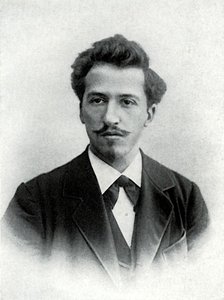
荷兰抽象派大师蒙德里安(1872-1944),以其新塑像主义风格闻名,运用纯粹的几何形状、基本色彩和直线创造出极简而富有表现力的作品。他的代表作如《红蓝黄构图》等,深刻影响了现代艺术与设计。
§ 3赏析
A Symphony in Primary Colors: Deconstructing Piet Mondrian’s “Composition No. V”
Piet Mondrian's "Composition No. V," painted in 1914, isn’t merely a painting; it’s an architectural blueprint for pure abstraction, a distillation of the artist’s lifelong quest to reveal the underlying structure of reality through geometric forms and elemental colors. This seminal work, housed within the MoMA's collection, offers a profound glimpse into the genesis of Neoplasticism – Mondrian’s revolutionary approach to art that sought to transcend representational imagery and capture the essence of universal harmony.
The canvas itself is dominated by a carefully orchestrated grid of black lines bisecting fields of vibrant color: assertive reds, cool blues, and sunny yellows. These aren't arbitrary choices; they are meticulously selected hues representing fundamental forces – red for energy and passion, blue for tranquility and spirituality, and yellow for intellect and illumination. The composition isn’t chaotic, despite its seemingly simple arrangement. Instead, it possesses a dynamic equilibrium, a visual tension that draws the eye across the surface while simultaneously suggesting an underlying order.
The Roots of Abstraction: Influences and Evolution
Mondrian's journey to this iconic composition was paved with experimentation. Initially trained as a landscape painter in the Dutch Impressionist tradition – evidenced by works like “The Red Mill” – he gradually moved away from depicting the external world, recognizing its inherent limitations in conveying spiritual truth. His early explorations of Pointillism and Fauvism provided valuable lessons in color theory and expressive brushwork, but ultimately proved insufficient to his artistic goals. He sought a more rigorous, intellectual approach, one that would strip away all superfluous detail and reveal the essential elements of art.
Crucially, Mondrian’s thinking was deeply influenced by Theosophy, a spiritual philosophy emphasizing the interconnectedness of all things. This belief informed his desire to create an art form that reflected this underlying unity – a visual language capable of communicating universal values beyond the limitations of individual experience. The influence of Japanese art, particularly its emphasis on asymmetry and negative space, also played a significant role in shaping his evolving style.
Deconstructing Form: The Language of Neoplasticism
“Composition No. V” is a textbook example of Neoplasticism – Mondrian’s systematic reduction of form to its most basic elements. He abandoned traditional perspective and representation, opting instead for a strictly orthogonal grid composed of horizontal and vertical lines. These lines aren't merely decorative; they define the spatial relationships within the painting, creating a sense of depth and structure. The colors themselves are applied in flat planes, devoid of shading or modeling, further emphasizing their purity and essential nature.
The black lines act as both dividers and connectors, delineating distinct areas while simultaneously linking them together to form a cohesive whole. This deliberate simplification wasn’t an exercise in minimalism; it was a conscious effort to reveal the underlying structure of reality – a world composed of fundamental geometric forms and elemental colors.
A Legacy of Harmony: Emotional Impact and Enduring Relevance
“Composition No. V” is more than just a visually striking artwork; it’s an invitation to contemplate the nature of beauty, order, and spirituality. The painting's stark simplicity and harmonious balance evoke a sense of calm and serenity, while its bold colors and assertive lines convey a feeling of energy and dynamism. It’s a testament to Mondrian’s belief that art could be a powerful tool for achieving spiritual enlightenment.
Today, “Composition No. V” continues to resonate with audiences around the world, serving as an enduring symbol of modernism and abstract art. Its influence can be seen in countless works of art, design, and architecture – a testament to Mondrian’s pioneering vision and his profound impact on the course of artistic history. Reproductions of this iconic piece offer a beautiful way to bring a touch of Mondrian's harmonious aesthetic into any space.
常见问题与解答
在哪里可以找到关于“Composition, V”的指南?
"Composition, V" 的指南请参阅作品的 指南 页面 —— 这是一份可打印的信息单,包含了该作品的说明、署名以及详细信息表(艺术家、日期、媒介、原尺寸、馆藏)。
蒙德里安 的《Composition, V》 的亮度是多少?
蒙德里安 的《Composition, V》 的亮度为 Gentle Luminance。亮度描述了色彩呈现出的反射光量。
蒙德里安 的《Composition, V》中的主导色调是什么?
蒙德里安 的《Composition, V》 的主导色调为 Golden Yellow Range,这一色调构成了整个色板的基调。


 切换至版画销售渠道


 对于任何边长超过 105 厘米(约 41 英寸)的艺术品或复制品,画框将以拆解后的组件形式发货。此方法可确保安全送达并防止运输过程中的损坏。


