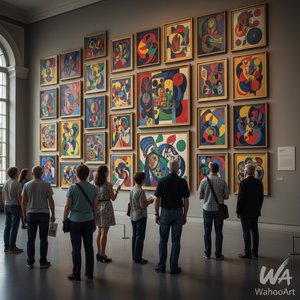
1912. Oil On Canvas.

§ 1目录数据


§ 2摘要
藏品详情
Explore Robert Delaunay’s ‘Rhythm’ (1912): A dynamic abstract composition of circles & geometric shapes in a vibrant color scheme. Cubist, energetic, and captivating!
 展开全文
展开全文
艺术家简介
探索抽象主义先驱罗伯特·德劳内 (1885-1941) 的艺术世界。他与妻子索尼娅·德劳内共同创立了奥菲斯派,以大胆的色彩和几何形状著称,代表作包括《埃菲尔铁塔》系列和《同时对比》,对现代艺术产生了深远影响。
§ 3赏析
A Symphony of Pure Light and Motion
In the early twentieth century, as the world accelerated into the modern age, Robert Delaunay captured its frantic, beautiful pulse in his 1912 masterpiece, Rhythm. This striking duo of panels serves as a cornerstone of early modernist abstraction, immediately captivating the viewer with a dynamic interplay of color and geometric precision. Rather than depicting a tangible landscape or a human figure, Delaunay invites us into a realm of pure sensation. Large, luminous circles are interwoven with squares and intersecting lines, creating an unmistakable impression of pulsating energy. It is a visual dance where form and color do not merely sit upon the canvas but seem to vibrate against one another, mimicking the very heartbeat of urban life and scientific discovery.
The artwork stands as a profound testament to the Orphism movement, a style Delaunay pioneered alongside his wife, Sonia Delaunay. Moving beyond the fragmented, monochromatic constraints of traditional Cubism, Rhythm embraces a bold, chromatic palette that celebrates the autonomy of color. The technique is nothing short of masterful; executed in oil on canvas, the painting showcases visible, intentional brushstrokes that lend a rich, tactile texture to the surface. Through the skillful use of color gradients and overlapping planes, Delaunay generates an extraordinary sense of depth and luminosity. This layering of pigment allows light to appear as if it is trapped within the circles themselves, creating a glowing effect that breathes life into the abstract composition.
The Dawn of Abstract Expression
To understand Rhythm is to understand a pivotal moment in art history when the boundaries of representation were being irrevocably shattered. Painted during the formative years of the avant-garde, this work reflects the broader European currents that sought to move past Impressionism toward a more distilled visual experience. Delaunay’s vision was not to replicate reality, but to capture its fundamental essence—movement, vibration, and harmony. By rejecting traditional spatial cues and embracing a flattened, asymmetrical perspective, he anticipated the revolutionary shifts of later movements like Surrealism and Expressionism. The painting acts as a bridge between the recognizable world and the limitless possibilities of non-figurative art.
For the discerning collector or interior designer, Rhythm offers more than just aesthetic beauty; it provides an emotional anchor of energy and playfulness. The bright, energetic tones and the rhythmic arrangement of shapes make it a commanding presence in any sophisticated space, capable of injecting vitality into a contemporary setting. It is a piece that speaks to the soul through its lack of literal subject matter, instead communicating through the universal language of light and geometry. Owning a high-quality reproduction of this work means bringing a fragment of the historical avant-garde into the home—a permanent celebration of the moment when art learned to sing in color.
常见问题与解答
《Rhythm》这一Cubism风格的作品传达了怎样的情感基调?
"Rhythm" 所蕴含的 Energetic 情感,与其 Cubism 风格相得益彰。
《Rhythm》属于 罗伯特·德劳内 (Luó Bótè Dé Lào Néi) 艺术生涯中的哪个时期?
"Rhythm" 展现了 罗伯特·德劳内 (Luó Bótè Dé Lào Néi) 在 Early Modern 时期的艺术风格。
"Rhythm" 创作于哪一年?
罗伯特·德劳内 (Luó Bótè Dé Lào Néi) 的《Rhythm》 创作于 1912 年。


 切换至版画销售渠道


 对于任何边长超过 105 厘米(约 41 英寸)的艺术品或复制品,画框将以拆解后的组件形式发货。此方法可确保安全送达并防止运输过程中的损坏。