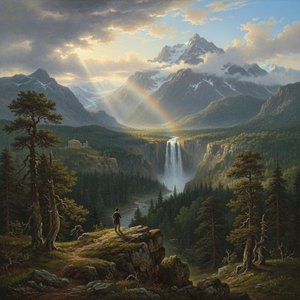
1852. Oil On Canvas, 280.0 x 221.0 cm. Taft Museum of Art.

§ 1目录数据

- 280.0 x 221.0 cm


§ 2摘要
藏品详情
Discover Robert Scott Duncanson’s ‘Landscape Mural,’ a serene 1852 Hudson River School painting. Explore its romantic style, atmospheric perspective & the artist's legacy.
 展开全文
展开全文
§ 3赏析
Robert Seldon Duncanson’s “Landscape Mural”: A Window into Romantic America
Robert Seldon Duncanson's "Landscape Mural," painted in 1852, isn’t merely a depiction of a serene vista; it’s a carefully constructed window into the heart of 19th-century American art and the evolving consciousness of its time. Commissioned by Nicholas Longworth, a prominent Cincinnati merchant and art patron, this monumental work—measuring an impressive 110 inches by 78 inches—represents a pivotal moment in Duncanson’s career and a significant contribution to the Hudson River School movement. More than just a pretty picture, it's a meditation on nature, spirituality, and the burgeoning sense of national identity taking shape within the United States.
The scene itself is deceptively simple: a winding river snakes through a densely wooded landscape, culminating in distant hills bathed in the soft light of a cloudy sky. Yet, beneath this apparent tranquility lies a complex layering of influences. Duncanson, deeply influenced by the European Romantic painters like Caspar David Friedrich and J.M.W. Turner, masterfully employs atmospheric perspective – a technique borrowed from the Northern Renaissance masters – to create an illusion of immense depth. The colors subtly shift with distance, suggesting both the vastness of the natural world and the limitations of human perception. The composition is carefully balanced, utilizing vertical elements like the trees to anchor the scene while the river provides a horizontal flow that guides the eye through the landscape.
A Pioneer’s Palette: Technique and Artistic Process
Duncanson's skill as a painter is evident in his meticulous attention to detail and his masterful use of oil paint. The brushstrokes are visible, contributing to the texture and richness of the scene—a hallmark of the Hudson River School style. He employed a layering technique, building up color gradually to achieve luminous effects and capturing the subtle nuances of light and shadow. Notably, Duncanson worked directly on the plaster walls of Longworth’s home, a practice known as “direct painting,” which allowed him to seamlessly integrate his artwork into the architecture. This method also meant that the mural was inherently tied to its environment, responding to the changing light and atmosphere within the room.
The choice of palette is particularly noteworthy. Duncanson favored muted earth tones—greens, browns, blues—creating a sense of quiet contemplation and harmony with nature. The subtle use of color evokes a feeling of nostalgia for a simpler time, reflecting the Romantic ideal of returning to nature as a source of spiritual renewal. He avoided dramatic contrasts or overly bright colors, opting instead for a more subdued and atmospheric approach that prioritized mood and emotion over literal representation.
Symbolism and the American Landscape
While superficially depicting a picturesque landscape, “Landscape Mural” is rich in symbolic meaning. The winding river can be interpreted as a metaphor for the journey of life, while the dense forest represents the mysteries and challenges that lie ahead. The distant hills symbolize aspiration and hope—a reminder of the potential for growth and fulfillment. Duncanson’s work reflects the growing American fascination with the natural world during this period, coinciding with westward expansion and the development of a distinct national identity.
Furthermore, Duncanson's background as an African American artist adds another layer of complexity to the mural's interpretation. Some scholars suggest that he subtly incorporated racial metaphors into his work, using the landscape to represent both the beauty and the challenges faced by Black Americans in a racially divided nation. The painting’s quiet dignity and contemplative mood can be seen as a powerful statement of resilience and hope in the face of adversity.
A Legacy of Beauty: Reproduction and Appreciation
Today, “Landscape Mural” stands as a testament to Duncanson's artistic vision and his enduring legacy. Reproductions offer a remarkable opportunity to experience the beauty and emotional depth of this iconic work. When selecting a reproduction, consider the quality of materials used—a high-quality print on archival paper will ensure that the colors remain vibrant for years to come. “Landscape Mural” continues to inspire artists and art lovers alike, reminding us of the power of nature to evoke emotion, stimulate contemplation, and connect us to something larger than ourselves.
常见问题与解答
在购买之前,我可以在自己的墙上预览 罗伯特·塞尔登·邓坎森 的《Landscape Mural》 吗?
通过作品的 AR 效果预览 页面,您可以在兼容设备上使用增强现实技术,在自己的墙面上预览 罗伯特·塞尔登·邓坎森 的《Landscape Mural》。
“Landscape Mural”的创作者是谁,属于什么风格?
"Landscape Mural" 的背后是 罗伯特·塞尔登·邓坎森 及其所属的 Hudson River School 流派。
罗伯特·塞尔登·邓坎森 的《Landscape Mural》 属于哪种艺术流派?
“Landscape Mural”是一件Hudson River School时期的作品。该艺术流派体现了作品所属的艺术传统。


 切换至版画销售渠道


 对于任何边长超过 105 厘米(约 41 英寸)的艺术品或复制品,画框将以拆解后的组件形式发货。此方法可确保安全送达并防止运输过程中的损坏。