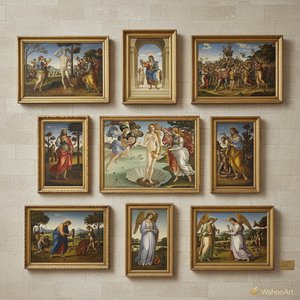
Oil On Panel.

§ 1目录数据


§ 2摘要
藏品详情
 展开全文
展开全文
§ 3赏析
A Triumph of Female Resolve: Botticelli’s *Judith’s Return to Bethulia*
Sandro Botticelli's Judith’s Return to Bethulia , painted around 1472 and currently residing within the hallowed halls of the Uffizi Gallery in Florence, is more than just a depiction of a biblical narrative; it’s a potent distillation of Renaissance ideals – courage, faith, and the enduring strength of women. This small-format tempera on panel offers an intimate glimpse into a pivotal moment: Judith's triumphant return to Bethulia bearing the severed head of Holofernes, the Assyrian general she had so cleverly deceived. Botticelli’s masterful handling of light and shadow, coupled with his signature graceful lines, elevates this scene beyond mere illustration, transforming it into a compelling meditation on victory and resilience.
The painting immediately draws the eye to Judith herself, rendered as a figure of remarkable composure amidst apparent chaos. Her face, subtly reminiscent of the central figure in Botticelli’s earlier *Fortitude* (1470), hints at a shared psychological depth – a quiet determination beneath an outward serenity. She carries the head of Holofernes within a simple sack, a stark symbol of her power and the subjugation of tyranny. Beside her stands Susanna, equally dignified, offering support and perhaps a reflection on their shared victory against adversity. The forest setting, rendered with atmospheric perspective, adds to the sense of drama and isolation, emphasizing Judith’s journey from danger to triumph.
The Renaissance Palette and Botticelli's Technique
Botticelli’s early style is evident in his use of tempera on panel – a technique favored for its luminous colors and ability to retain detail. The palette is rich yet restrained, dominated by earthy tones—ochres, browns, and deep reds—contrasting sharply with the pale flesh of the women. Notice how Botticelli employs *sfumato*, a subtle blurring of lines and edges, particularly around Judith’s face, creating an ethereal quality that softens her features while simultaneously emphasizing her strength. The meticulous rendering of fabric – the sack, Susanna's cloak – demonstrates Botticelli’s dedication to anatomical accuracy and his keen observation of the natural world.
Interestingly, the painting reveals influences from artists like Antonio del Pollaiolo and Mantegna, both known for their dramatic compositions and expressive figures. Botticelli seems to have absorbed elements of their style while maintaining a distinctly personal vision. The dynamic pose of Judith, holding aloft the head of Holofernes, echoes the heroic gestures found in earlier Renaissance art, but Botticelli imbues it with a uniquely human vulnerability.
Symbolism and Biblical Narrative
The story of Judith is steeped in symbolism. Judith herself represents Jewish courage and faith in the face of overwhelming odds. Her deception of Holofernes highlights the power of intelligence and strategic thinking as weapons against brute force. The sack containing the head symbolizes not just victory, but also a warning to all who would threaten the Israelites. It’s a potent reminder that even the most formidable enemies can be overcome through cunning and divine assistance.
Beyond the immediate narrative, *Judith’s Return to Bethulia* speaks to broader Renaissance themes of virtue, honor, and the role of women in society. In an era where female figures were often relegated to passive roles, Botticelli presents Judith as a proactive agent of change – a warrior queen who secures her people's freedom through her own actions. The painting’s enduring appeal lies in its ability to resonate with viewers across centuries, offering a timeless celebration of female strength and resilience.
Bringing Botticelli Home: High-Quality Reproductions
Botticelli’s *Judith’s Return to Bethulia* is a cornerstone of the Italian Renaissance. At AllPaintingsStore.com , we are proud to offer meticulously crafted, hand-painted oil painting reproductions that capture the essence and beauty of this iconic masterpiece. Our skilled artisans utilize traditional techniques and archival-quality materials to create faithful representations that will grace your home or office with Botticelli’s genius. Whether you're an art enthusiast, a collector, or simply seeking to add a touch of Renaissance elegance to your space, our reproductions provide an accessible and authentic way to experience the power and artistry of this remarkable painting.
常见问题与解答
我可以在不同的光线下查看波蒂切利 的《Judith's Return to Bethulia》吗?
波蒂切利 的《Judith's Return to Bethulia》 的 X 光视图可在作品的 X射线透视 页面查看:通过十一层光学图层对图像进行交互式深度解析。
哪里可以买到波蒂切利 的《Judith's Return to Bethulia》的手绘复制品?
您可以在波蒂切利 的《Judith's Return to Bethulia》的手工油画复刻页面直接订购其手绘复制品:亚麻画布手工油画复制品,按需定制。
针对 波蒂切利 的《Judith's Return to Bethulia》,建议采用怎样的打印尺寸与方向?
对于“Judith's Return to Bethulia”,建议的打印设置尺寸为 Medium,方向为 Portrait。


 切换至版画销售渠道


 对于任何边长超过 105 厘米(约 41 英寸)的艺术品或复制品,画框将以拆解后的组件形式发货。此方法可确保安全送达并防止运输过程中的损坏。