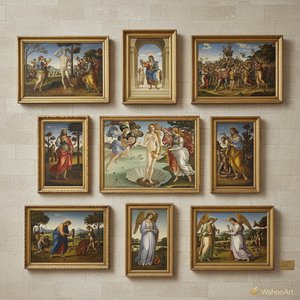
Oil On Canvas.

§ 1目录数据


§ 2摘要
藏品详情
Botticelli’s ‘Primavera’ – a stunning Renaissance detail! Explore this exquisite oil painting of flowing drapery & floral beauty. Discover the elegance of Florence's golden age.
 展开全文
展开全文
§ 3赏析
A Glimpse into Paradise: Botticelli’s ‘Primavera’ Detail
This exquisite detail from Sandro Botticelli's masterpiece, *Primavera*, offers a captivating study in Renaissance artistry. Focusing on the lower legs and feet of two figures draped in flowing white fabric, this fragment invites us to contemplate the larger narrative of rebirth and flourishing that defines the complete work. It’s a testament to Botticelli’s skill in rendering both anatomical accuracy and ethereal beauty.Subject & Composition
The composition centers on the delicate interplay between form and drapery. The pale skin tones of the figures' legs and feet are strikingly contrasted against the dark, richly detailed background – a lush garden teeming with flowers and foliage. This vertical orientation emphasizes the length of the limbs and the graceful folds of the garments, drawing the eye downwards into the scene. The arrangement isn’t merely aesthetic; it subtly guides our gaze towards the symbolic ground upon which these figures stand.Style & Technique
Botticelli's style is immediately recognizable: a harmonious blend of late Gothic elegance and emerging Renaissance naturalism. He masterfully employs line to define form, creating an almost lyrical quality in the depiction of the bodies and clothing. The technique involves layering thin glazes of oil paint on canvas, building up color and luminosity with remarkable subtlety. This glazing creates a soft, diffused light that enhances the three-dimensionality of both figures and their surroundings. The meticulous detail evident in the fabric’s patterns and floral elements is characteristic of Botticelli's dedication to precision.Historical Context & Symbolism
Created around 1482, *Primavera* was commissioned by the Medici family, powerful patrons of the arts during the Florentine Renaissance. The painting is widely interpreted as an allegory of spring and a celebration of love, fertility, and renewal. The bare feet often symbolize innocence, vulnerability, or a connection to the earth – grounding these figures within a paradise-like garden. This garden itself represents not just nature’s bounty but also potentially the Garden of Venus, evoking themes of earthly delight and spiritual awakening. Primavera reflects the humanist ideals prevalent during the Renaissance, which sought to reconcile classical mythology with Christian beliefs.Emotional Impact & Interior Design Considerations
This detail evokes a sense of serenity, grace, and timeless beauty. The soft lighting and delicate rendering create an atmosphere of peaceful contemplation. As a reproduction, this fragment would lend itself beautifully to a variety of interior design schemes.- Classical Interiors: It complements traditional settings with ornate detailing.
- Modern Spaces: Provides a sophisticated touch when contrasted against minimalist décor.
- Botanical Themes: Enhances rooms featuring floral patterns or natural elements.
常见问题与解答
在“Primavera - (11)”中,媒介与笔触是如何交融的?
在“Primavera - (11)”中,Oil On Canvas技法与Early Renaissance运动交相辉映。
波蒂切利 的《Primavera - (11)》 的色彩是鲜艳夺目还是柔和低调?
波蒂切利 的《Primavera - (11)》 的色彩呈现出 Muted 的饱和度。饱和度描述了色彩的鲜艳或柔和程度。
波蒂切利 的作品《Primavera - (11)》知名度如何?
“Primavera - (11)”的受欢迎程度被归类为Iconic。


 切换至版画销售渠道


 对于任何边长超过 105 厘米(约 41 英寸)的艺术品或复制品,画框将以拆解后的组件形式发货。此方法可确保安全送达并防止运输过程中的损坏。