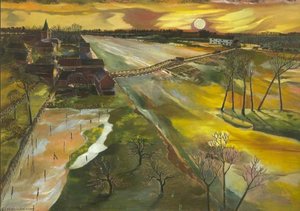
A Soldier Painter’s Vision of War
The life of Albert Richards was a poignant intersection of artistic devotion and the brutal realities of mid-twentieth-century conflict. Born in Liverpool on December 13, 1919, to Hannah Beatty and George Richards, his early years were shaped by the quiet strength of a working-class household in Wallasey, Cheshire. His father, a veteran of the Great War, instilled in him a profound sense of duty and resilience—virtues that would later define both his military service and his approach to the canvas. From a young age, Richards found solace and inspiration in the landscapes surrounding his home, developing an eye for the subtle nuances of light and terrain that would eventually become the hallmark of his wartime documentation.
His formal journey into the world of fine art began at Wallasey Central School, leading him to the prestigious Wallasey School of Art and Crafts. His talent was so undeniable that he secured a scholarship from the Borough of and Wallasey to attend the Royal College of Art, beginning his studies in early 1940. It was within these hallowed halls that Richards was exposed to the cutting-edge movements of the era, including Cubism and Surrealism. These modernist influences provided him with an experimental toolkit, allowing him to move beyond mere representation toward a more visceral, textured way of capturing the world around him.
The Canvas of Conflict
The outbreak of World War II fundamentally redirected the trajectory of Richards’s life, transforming him from a student of art into a chronicler of combat. In May 1941, the War Artists Advisory Committee (WAAC) recognized his unique ability to merge technical skill with the raw immediacy of a soldier's perspective and recruited him for a commission. Though he initially found great fulfillment in the Parachute Regiment—a role that offered both physical challenge and artistic stimulation—he ultimately accepted the call to document the unfolding struggle. This period saw him translating the adrenaline of airborne operations into enduring works of art.
Richards’s work from this era is characterized by a remarkable ability to capture movement and atmosphere. During his extensive parachute training at RAF Ringway, he produced evocative pieces such as “Kilkenny’s Circus” and “Parachute Training Over Tatton Park,” which meticulously detail the physicality of the descent. His later commissions took him into the heart of major military operations, including Operation Mush, where he participated in large-scale parachute drops over Gloucestershire. Whether depicting the chaotic energy of a sky filled with silk or the somber stillness of a frozen trench, his paintings possess an emotional weight that transcends simple reportage.
Legacy and Artistic Mastery
The technical breadth of Richards’s oeuvre is nothing short of extraordinary, ranging from the expressionistic to the deeply realistic. In works like “Take Off and Landing Field,” one can witness his use of impasto textures and dramatic sunset hues to convey a sense of cinematic grandeur. Conversely, his more somber compositions, such as “Sappers Erecting Pickets in the Snow” or “Royal Engineers’ Dump,” utilize geometric forms and a muted palette to evoke the stark, often harrowing reality of life on the front lines. His ability to find beauty within the grim machinery of war remains his most significant contribution to the history of British art.
Tragically, Richards’s life was cut short in 1945, making him the youngest of the three British official war artists killed during the conflict. Yet, through his surviving works, his vision remains undimmed. He left behind a legacy that serves as both a historical record and a profound meditation on human endurance. His paintings do more than just show us what the war looked like; they allow us to feel the tension of the drop, the chill of the winter trenches, and the unwavering spirit of those who served.
问答详情
Albert Richards 最常使用的色彩有哪些?
Albert Richards 作品的色彩特征展示在艺术家的 色彩基因 页面上。
如何按特定色调查找 Albert Richards 的作品?
您可以在Albert Richards的按色调浏览页面上,按色调浏览其作品。
如何按年份顺序浏览 Albert Richards 的作品?
您可以在Albert Richards的作品时间轴页面上按时间顺序查看其作品。