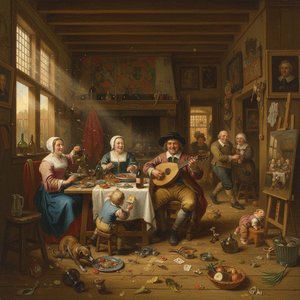
A Quiet Intimacy: The World of Alexander Hugo Bakker Korff
Alexander Hugo Bakker Korff, a name perhaps less immediately recognized than some of his Dutch contemporaries, nevertheless occupies a significant and charming niche within the landscape of 19th-century genre painting. Born in The Hague in 1824 and passing away in Leiden in 1882, his life unfolded amidst a period of artistic transition, bridging the echoes of the Golden Age with the burgeoning currents of Realism and the subtle shifts toward Impressionism. Bakker Korff wasn’t concerned with grand historical narratives or sweeping landscapes; instead, he dedicated himself to capturing the quiet poetry of domesticity, particularly through his celebrated series known as the “Bakker Korffjes.” These intimate scenes offer a captivating glimpse into the lives of middle-class women in the Netherlands, rendered with meticulous detail and an atmosphere of serene contemplation.Formative Years and Artistic Development
Bakker Korff’s artistic journey began with formal training at the Koninklijke Academie van Beeldende Kunsten in The Hague during the 1840s, a foundation upon which he would build his distinctive style. He further refined his skills at the Koninklijke Academie voor Schone Kunsten in Antwerp, studying under the guidance of Nicolaes de Keyser, a prominent figure in Dutch genre painting. Early influences from painters like Cornelis Kruseman and Huib van Hove are discernible in his initial works, yet Bakker Korff soon began to forge his own path. He gravitated towards interior scenes populated by women engaged in everyday activities – reading, sewing, writing letters, or simply lost in thought. It was this focus on the domestic sphere, coupled with a particular fondness for depicting ladies adorned in the fashionable caps of the era, that would ultimately define his artistic signature and give rise to the beloved “Bakker Korffjes.” These weren’t merely portraits; they were carefully constructed narratives, imbued with a sense of psychological depth and emotional resonance.The ‘Bakker Korffjes’: A World in Miniature
Around 1856, while residing in Oegstgeest alongside his sisters—who frequently served as his models—Bakker Korff embarked on the creation of his signature series. The “Bakker Korffjes” are characterized by an extraordinary level of detail, a warm and inviting palette, and a pervasive sense of quiet intimacy. These paintings aren’t dramatic or overtly expressive; their power lies in their subtlety, in the way Bakker Korff captures the fleeting moments of everyday life with such precision and sensitivity. The women he depicts appear absorbed in their tasks, yet there's often an underlying current of emotion – a hint of melancholy, a spark of curiosity, or a quiet sense of contentment. He masterfully rendered textures—the delicate fabrics of dresses, the smooth surfaces of furniture, the soft glow of candlelight—creating scenes that feel remarkably tangible and real. The compositions are carefully balanced, drawing the viewer’s eye to the central figure while simultaneously revealing details about her surroundings, offering clues about her social status and personal life.Legacy and Artistic Significance
Bakker Korff's work is deeply rooted in the Dutch tradition of genre painting, a legacy stretching back to the masters of the Golden Age. However, his style also reflects the influence of The Hague School, known for its realistic depictions of Dutch society and landscapes. He wasn’t simply replicating reality; he was interpreting it through a lens of empathy and understanding, offering a nuanced portrayal of women's lives in 19th-century Netherlands. His paintings provide valuable insights into the social customs, material culture, and domestic routines of the period. In 1870, his talent received official recognition when he was awarded the title of Knight in the Order of Leopold after exhibiting his works in Brussels. He remained actively involved in the artistic community throughout his career, serving as a member and later a board member of Pulchri Studio in The Hague, and holding a position within the Leids Schilder- en Tekengenootschap Ars Aemula Naturae. Though perhaps not a household name today, Alexander Hugo Bakker Korff’s legacy endures through the enduring charm and quiet beauty of his “Bakker Korffjes,” offering a timeless window into a bygone era.Pupils
- Dirk Leonardus Kooreman
- Jan Hendrik van Rossum du Chattel
- Elias Stark
- Jan Jacob Zuidema Broos
- Mathilde Tonnet
问答详情
我可以通过主题来探索 Alexander Hugo Bakker Korff 的作品吗?
Alexander Hugo Bakker Korff 的 主题图谱 是一个按主题对艺术家作品进行索引的页面。
在哪里可以按时间顺序欣赏 Alexander Hugo Bakker Korff 的作品?
您可以在Alexander Hugo Bakker Korff的作品时间轴页面上按时间顺序查看其作品。
Alexander Hugo Bakker Korff 出生于哪个城市和国家?
Alexander Hugo Bakker Korff 出生于 Netherlands 的 The Hague。