A Legacy Etched in Stone: The Life of Alojzy Misierowicz
In the vibrant tapestry of nineteenth-century Polish art, few names resonate with the quiet, enduring precision of Alojzy Misierowicz. Born in 1825 amidst the storied streets of Warsaw, Misierowicz entered a world where the pulse of Polish culture was deeply intertwined with its architectural and historical grandeur. Growing up within a lineage of artists, his early years were not merely an education in aesthetics but a profound immersion into the very soul of craftsmanship. This familial heritage provided him with a foundational reverence for detail, nurturing a talent that would eventually allow him to translate the ephemeral beauty of landscapes and monuments into the permanent, tactile medium of lithography.
As he matured, Misierowic’s artistic journey became defined by his mastery of the lithographic stone. Unlike the more common etching techniques of his era, lithography offered a unique opportunity for tonal richness and fluid expression, allowing for multiple impressions that could bring art to the wider public. He embraced this technical challenge with a singular devotion, honing an ability to manipulate light and shadow with such remarkable accuracy that his prints often felt less like reproductions and more like windows into the past. His work became a bridge between the fleeting moment and historical permanence, capturing the essence of a nation through the meticulous rendering of its most cherished sites.
A Symbiotic Vision: The Collaboration with Napoleon Orda
The zenith of Misierowicz’s career was undoubtedly marked by his profound artistic partnership with Napoleon Orda, the celebrated architect and chronicler of Polish heritage. This collaboration was far more than a mere professional arrangement; it was a shared mission to document and preserve the visual identity of Poland during a period of significant historical transition. Together, they embarked on ambitious projects that sought to immortalize the grandeur of the Polish landscape and its architectural treasures.
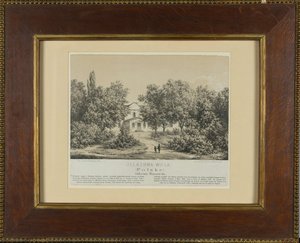
One of their most poignant achievements remains the lithographic rendering of “Żelazowa Wola according to a drawing by Napoleon Orda.” In this work, Misierowicz’s technical prowess is on full display, as he captures the delicate atmosphere and structural integrity of Orda’s architectural visions with breathtaking fidelity. Through his hands, Orda's sketches were transformed into evocative black and white scenes that breathed life into historical moments. The significance of this partnership is cemented by the fact that such vital works continue to reside in prestigious institutions, such as the Fryderyk Chopin Institute in Warsaw, ensuring that their collective contribution to Polish visual culture remains an indelible part of the national memory.
Technical Mastery and Historical Significance
The artistry of Alojzy Misierowicz is characterized by a relentless pursuit of accuracy and a deep respect for the subject matter. His oeuvre serves as a vital historical archive, providing contemporary viewers with a window into the architectural splendor and social landscapes of the 19th century. Beyond his technical skill, there is an emotional resonance in his work—a sense of nostalgia and reverence that speaks to the preservation of identity through art.
His contributions can be summarized through several key pillars of his legacy:
- Technical Innovation: His mastery of lithography allowed for a level of detail and tonal complexity that elevated the medium of printmaking in Poland.
- Cultural Preservation: Through his collaborative works, he helped document architectural monuments and historical scenes that might otherwise have been lost to time.
- Artistic Lineage: As a product of a family of artists, he carried forward a tradition of excellence that bridged the gap between classical craftsmanship and modern printing techniques.
- Historical Impact: His prints remain essential primary sources for understanding the visual landscape of 19th-century Poland, held in significant collections across Europe.
Ultimately, Alojzy Misierowicz was more than a printmaker; he was a custodian of history. Through the delicate interplay of ink and stone, he ensured that the architectural majesty and historical spirit of his homeland would endure long after the passing of his era, leaving behind a legacy as permanent and profound as the stones upon which he worked.
问答详情
Alojzy Misierowicz 的创作时期属于哪个历史阶段?
Alojzy Misierowicz 的创作时期处于 19th Century 时期。这一时期确立了艺术家在历史中的地位。
Alojzy Misierowicz 的作品传达了怎样的情绪?
艺术家的 心情空间 页面展示了 Alojzy Misierowicz 按氛围分类排列的艺术作品。
如何按特定媒介查找 Alojzy Misierowicz 的所有作品?
全部媒介 页面按技法对 Alojzy Misierowicz 的作品进行了分类。