A Life Immersed in Realism
Antoine Vollon, a name perhaps less immediately recognizable than some of his contemporaries, occupies a fascinating and significant niche within the landscape of 19th-century French painting. Born in Lyon in 1833, Vollon’s artistic journey was one of dedicated craftsmanship and a persistent pursuit of capturing the tangible world around him. His father, an ornamental craftsman, instilled in him an appreciation for texture and detail – qualities that would become hallmarks of his mature style. Initially apprenticed to an engraver, young Antoine also gained practical experience decorating enamelled pans and stoves, a seemingly humble beginning that nonetheless honed his skills in manipulating light and surface. This early exposure to applied arts proved invaluable, laying the groundwork for his later mastery of still life compositions. Though he formally studied at the École des Beaux-Arts in Lyon under Jehan Georges Vibert, much of Vollon’s initial artistic development was self-directed, fueled by an innate talent and a burgeoning passion for painting.Parisian Influences and Artistic Development
The pivotal moment in Vollon's career arrived with his relocation to Paris in 1859. The vibrant artistic atmosphere of the capital proved transformative. He quickly sought guidance from Théodule Ribot, a prominent figure in the realist movement, and immersed himself in the study of 17th-century Dutch still life masters. This influence is readily apparent in Vollon’s meticulous attention to detail, his rich color palettes, and his ability to imbue everyday objects with a sense of weight and presence. Paris also introduced him to a stimulating social circle that included literary giants like Alexandre Dumas and fellow artists such as Honoré Daumier and Charles-François Daubigny. These interactions fostered a dynamic exchange of ideas and further solidified Vollon’s commitment to representing the world as he observed it, without idealization or romantic embellishment. He wasn't merely copying reality; he was interpreting it through his unique sensibility, seeking beauty in the commonplace.Navigating the Salon and Achieving Recognition
Vollon ambitiously extended his artistic scope beyond still lifes, a genre often relegated to lower status within the rigid hierarchy of the Parisian Salon system. He aspired to create compelling figure paintings, and achieved significant success with *Femme du Pollet à Dieppe (Seine-Inferieure)* in 1876, winning first prize at the prestigious Salon. However, this triumph was met with a famously dismissive critique from Édouard Manet, who likened the painting to “a basket that walks.” While undoubtedly stinging, this remark didn’t deter Vollon; instead, it seemed to reinforce his dedication to his chosen path. He continued to refine his technique, focusing on capturing the subtle nuances of light and texture, and building a reputation for meticulous craftsmanship. Throughout his career, Vollon garnered numerous accolades – third-class, second-class, and first-class medals at the Salon in 1865, 1868, and 1869 respectively – demonstrating consistent recognition from his peers and the art establishment. He served as a member of the Salon’s jury for ten years beginning in 1870, further solidifying his position within the French art world. His contributions were also formally acknowledged with appointments as a Chevalier and later an Officer of the Legion of Honor, culminating in his election to the Académie des Beaux-Arts in 1897 – a testament to his enduring influence and artistic merit.A Lasting Legacy
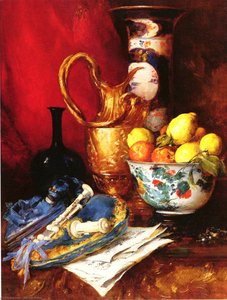
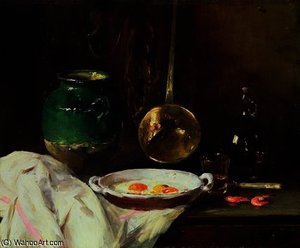
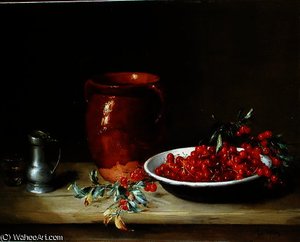
Antoine Vollon’s impact extended beyond his own paintings; he was also a dedicated teacher, nurturing the talents of several aspiring artists including Raymond Allègre, Joseph Garibaldi, Henri Michel-Lévy, Théo Mayan, and Gustave le Sénéchal de Kerdréoret. His son, Alexis Vollon, followed in his footsteps, continuing the family’s artistic legacy. Today, Vollon is remembered not only through his artwork but also through geographical tributes – streets bearing his name in Bessancourt and Paris, and an intersection with a fountain dedicated to him in Lyon. While perhaps overshadowed by some of the more radical innovators of his time, a retrospective exhibition at PaceWildenstein in New York in 2004 sparked renewed interest in his work, prompting critics to acknowledge the sensuous quality of his paintings and recognize his unique contribution to French Realism. Vollon’s works – such as *Mound of Butter* (1885), *Still Life of a Basket with Fruits*, and *Still Life with Cheese* (1870) – continue to captivate viewers with their luminous surfaces, masterful compositions, and enduring celebration of the beauty found in everyday life. He remains a painter’s painter, admired for his technical skill and unwavering dedication to capturing the essence of the visible world.问答详情
Antoine Vollon 来自哪里?
Antoine Vollon 出生于 France。
Antoine Vollon 的艺术生涯是如何划分为不同时期的?
您可以在艺术家的 艺术历程 页面上查阅 Antoine Vollon 作品的编年史,其作品按创作顺序分章节依次呈现。
可以按媒介类型浏览 Antoine Vollon 的作品吗?
若要查找Antoine Vollon在特定媒介下的所有作品,请访问艺术家的所有媒介页面。