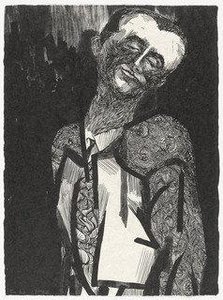
A Voice of Witness Through Woodcuts
Antonio Frasconi stands as a singular figure in the tapestry of Uruguayan and American art history, a master of the woodcut print whose work serves as a profound medium for social commentary. Born on April 28th, 1919, amidst the rhythmic motion of a vessel traversing the waters between Argentina and Uruguay, Frasconi’s very origin was one of transition and movement. Raised in the vibrant cultural landscape of Montevideo, his formative years were deeply colored by his family's Italian heritage and the resilience required of those navigating the shifts of the early twentieth century. His parents, who had emigrated to South America during the upheaval of World War I, instilled in him a perspective on life shaped by displacement and the strength found in cultural identity.
The seeds of his artistic devotion were sown much earlier than his formal training. Frasconi often recalled the transcendent view held by his mother, a restaurant proprietor and seamstress, who spoke of art not as a mere human endeavor but as something akin to divine creation. This spiritual reverence for the creative act fueled a lifelong fascination with expression that transcended the boundaries of simple decoration. While he briefly explored the traditional paths of the Beaux Arts, Frasconi found his true calling in the tactile, demanding world of printmaking. He honed his craft at the Círculo de Bellas Artes in Montevideo, where he began to develop a visual language informed by the dramatic storytelling of masters like Gustave Doré and Francisco Goya.
The Evolution of an Expressive Vision
As the shadows of the Second World War reshaped the global landscape, so too did they expand Frasconi’s artistic horizons. An encounter with exhibitions showcasing Impressionism and Post-Impressionism ignited a new imaginative fire, introducing him to the emotive power of Vincent van Gogh and the structural brilliance of Paul Cézanness. Yet, it was the woodcuts of Paul Gauguin that left an indelible mark on his soul, providing a blueprint for how texture and bold form could communicate deep-seated human truths. This period of discovery also saw him delving into the expansive poetic vision of Walt Whitman, finding in American literature a mirror for his own explorations of identity and cultural exchange.
In 1945, Frasconi’s journey took a definitive turn with his move to the United States. His early years in America were marked by a period of diverse labor, working as a gardener and a museum guard, roles that allowed him to observe the world through a quiet, attentive lens. This observational period enriched his work, allowing him to weave complex, multilingual narratives into his prints. His technique became a bridge between worlds; while he is celebrated for the stark, powerful lines of his woodcuts and linocuts, his ability to manipulate medium—as seen in the gestural expressionism of works like Sardine Fisherman I—demonstrates a versatility that captures both the raw energy of maritime life and the heavy atmosphere of political struggle.
Legacy of Social Commentary and Symbolism
The true significance of Antonio Frasconi lies in his role as an artist-witness. His work frequently grappled with the weight of history, using the stark contrasts of printmaking to address themes of injustice, dictatorship, and the human condition. Whether through the surreal, symbolic detail of his monochrome drawings or the biting social critiques found in his series of prints, Frasconi utilized the graphic nature of the woodcut to ensure his message was both visible and visceral. His art was never static; it was a dynamic dialogue between the personal and the political, often reflecting the tensions of the civic-military dictatorships that haunted the Southern Cone.
Throughout his long and prolific career, Frasconi achieved a rare synthesis of technical mastery and intellectual depth. His ability to integrate literary themes with visual motifs created a body of work that remains as relevant today as when it was first carved into wood. He leaves behind a legacy defined by:
- Mastery of Printmaking: A profound command over woodcut, linocut, and etching that utilized texture and line to evoke emotion.
- Social Advocacy: The use of art as a tool for political commentary and the documentation of historical struggle.
- Cultural Synthesis: An artistic identity that seamlessly blended his Uruguayan roots with his American experiences through multilingual narratives.
- Narrative Depth: A lifelong commitment to exploring complex themes of displacement, resilience, and the human spirit.
问答详情
我可以通过艺术流派来浏览 Antonio Frasconi 的作品吗?
Antonio Frasconi 所属的艺术流派可以在其 所有艺术流派 页面中查看,该页面按流派对作品进行了分类。
在哪里可以按技法分类浏览 Antonio Frasconi 的作品?
全部媒介 页面按技法对 Antonio Frasconi 的作品进行了分类。
Antonio Frasconi 出生于哪个城市和国家?
Antonio Frasconi 出生于 Argentina 的 Buenos Aires。