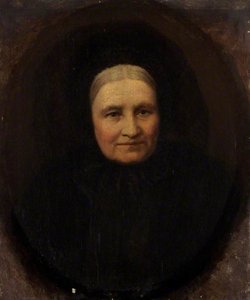
Barnett Samuel Marks: A Welsh Painter Bridging Tradition and Social Realism
Barnett Samuel Marks (1827-1916) stands as a compelling figure in 19th and early 20th century British art, a painter whose career unfolded across Cardiff and London, marked by both the refinement of classical portraiture and a growing engagement with social issues. Born into a prominent Jewish family deeply rooted in Welsh commerce and culture, Marks’ life was one of artistic ambition tempered by familial obligations and a keen awareness of his community's evolving role within British society. His legacy lies not just in the elegant portraits he created – many commissioned by wealthy patrons – but also in the poignant depictions of poverty and childhood that emerged later in his career, revealing a sensitive artist grappling with the complexities of his time.
Marks’ early life in Cardiff was one of privilege and cultural immersion. The Marks family were significant figures in the city's burgeoning Jewish community, involved in trade, finance, and social affairs. Barnett received a private education, supplemented by artistic instruction, demonstrating an early aptitude for both music and painting. He quickly established himself as a portrait artist, catering to a clientele that included members of Cardiff’s elite – the Marchioness of Bute being particularly influential in his career. His style during this period leaned heavily towards the neoclassical tradition, characterized by meticulous detail, balanced compositions, and an emphasis on capturing the dignity and character of his subjects. These early portraits, often depicting nobility and prominent figures, showcase a mastery of technique and a keen eye for likeness – qualities that secured him recognition at the Royal Academy in London.
- Early Influences: While Marks’ formal training remains somewhat undocumented, it's clear he was influenced by the prevailing artistic currents of his time. The classical ideals championed by artists like Ingres and David undoubtedly shaped his early work.
- Cardiff Connections: His strong ties to Cardiff – both professionally and personally – remained a constant throughout his life. He continued to exhibit in the city, support local initiatives, and maintain connections with fellow artists and cultural figures.
The Transition to Social Realism
A pivotal moment in Marks’ artistic development occurred during the 1860s, coinciding with his move to London. The experience of urban poverty – particularly the plight of children – profoundly impacted him. Witnessing the stark realities of Victorian society fueled a desire to depict these issues through his art. This shift is most dramatically illustrated by his series of diptychs depicting young boys before and after their rescue by Dr. Barnardo’s Homes. These works, characterized by their emotional intensity and unflinching portrayal of hardship, marked a significant departure from the idealized portraits that had defined much of his earlier career.
The reception to these social realist paintings was notably positive, with critics praising Marks' ability to convey empathy and compassion. Ruskin himself offered encouragement, recognizing the power of his work to raise awareness about the plight of vulnerable children. This period demonstrated a willingness to engage with contemporary social concerns – a characteristic that distinguished him from many of his contemporaries.
- Dr. Barnardo’s Homes Series: These paintings are arguably Marks' most significant contribution to social commentary, offering a stark contrast to the formal portraits he had previously produced.
- Ruskin’s Endorsement: The praise from John Ruskin highlighted the artistic merit and social impact of these works.
A Royal Cambrian Academician and Continued Artistic Activity
Barnett Samuel Marks' career continued to flourish throughout the late 19th and early 20th centuries. In 1887, he was elected a full member of the Royal Cambrian Academy, a prestigious honor that recognized his contributions to Welsh art. This affiliation solidified his position within the artistic community and provided him with further opportunities for exhibition and recognition. He remained active in Cardiff, supporting local initiatives and continuing to paint portraits on commission.
Beyond portraiture, Marks also engaged in landscape painting, often depicting scenes of the Welsh countryside – a reflection of his strong ties to his birthplace. His later works demonstrate a growing interest in capturing the atmospheric qualities of light and shadow, suggesting an evolving artistic sensibility. He was a member of Freemasonry for over 50 years, serving as Master of the Buckingham and Chandos Lodge, further cementing his place within London’s social and cultural elite.
- Royal Cambrian Academician: This honor reflected Marks' standing as a respected artist in Wales.
- Landscape Painting: His later works reveal an exploration of landscape themes alongside portraiture.
Legacy and Historical Significance
Barnett Samuel Marks’ artistic legacy is complex and multifaceted. He was a skilled portraitist who successfully navigated the conventions of Victorian society, capturing the likenesses of prominent figures with technical precision and elegance. However, he was also an artist willing to confront social issues and express his compassion for those less fortunate. His shift towards social realism represents a significant moment in his career – a testament to his artistic integrity and his commitment to using art as a means of engaging with the world around him.
Marks’ work offers valuable insights into Victorian society, reflecting both its wealth and its poverty, its formality and its compassion. His paintings serve as reminders of a time when artists were increasingly expected to engage with social concerns – a tradition that continues to resonate today. Barnett Samuel Marks remains an important figure in British art history, a painter whose career spanned decades and whose work continues to be studied and appreciated for its technical skill, emotional depth, and historical significance.
Further Resources:
- Reverend Dr Thomas Davies
- Barnett Samuel Marks
- Biography of Barnett Samuel Marks (Victorian painter)
- Artist Biography & Facts Barnett Samuel Marks - askART
- Wikipedia: Barnett Samuel Marks
问答详情
在哪里可以按关键词浏览 Barnett Samuel Marks 的作品?
您可以通过艺术家关键词分类页面,按关键词探索Barnett Samuel Marks的作品。每个关键词都汇集了相关的艺术品。
Barnett Samuel Marks 的哪些作品浏览量最高?
有关 Barnett Samuel Marks 作品的统计数据,请参阅艺术家的 统计数据 页面。
Barnett Samuel Marks 最常使用的色彩有哪些?
您可以在Barnett Samuel Marks的色彩基因页面上,深入研究其在本站所列作品中的色彩运用。