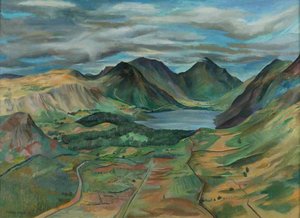
The Quiet Majesty of the English Landscape: The Life of Bateson Mason
In the tapestry of mid-twentieth-century British art, few threads are woven with as much serene precision as those left by Frank Bateson Mason. Born in 1910 in Thackley, Bradford, Mason emerged from the rugged, industrial heart of Yorkshire to become a definitive voice in landscape painting. His journey was one of disciplined refinement, beginning with his formative years at the Bradford School of Art between 1927 and 1932. It was during this period that his innate sensitivity to form began to coalesce, eventually leading him to the prestigious Royal College of Art. Under the transformative mentorship of Sir William Rothenstein, Mason’s artistic sensibilities were profoundly shaped, as he learned to balance a meticulous attention to detail with a deeper, more atmospheric understanding of the natural world.
Mason’s early fascination with architecture provided him with a structural foundation that would later inform his approach to the landscape. He viewed the earth not merely as a collection of organic shapes, but as a composition of weight, light, and enduring form. This architectural eye allowed him to capture the dramatic vistas of Yorkshire’s national parks with a sense of permanence and grandeur. As he transitioned from student to educator, teaching at both Bromley College of Art and Chelsea School of Art, his work began to reflect a sophisticated dialogue between the physical reality of the terrain and the ephemeral qualities of light and weather.
Technique, Palette, and the Impressionist Legacy
The brilliance of Mason’s technique lies in his ability to evoke the very breath of the English countryside. Heavily influenced by the principles of Impressionism and Post-Impressionism—most notably the structural color explorations of Cézanne—Mason developed a style that prioritized tonal accuracy and textural depth. He did not rely on garish or distracting hues; instead, he favored a restrained, thoughtful palette dominated by muted greens, deep blues, and earthy browns. This choice allowed him to faithfully reproduce the subtle shifts in atmospheric conditions, from the misty morning light over a lake to the golden, heavy air of an autumn afternoon.
His brushwork was never haphazard; rather, it was deliberate and considered, utilizing layering to create a sense of luminosity that seems to emanate from within the canvas itself. This method allowed him to capture the ruggedness of stone and the softness of foliage with equal mastery. Through his careful application of paint, Mason could transform a simple scene into a profound meditation on time and nature, making the viewer feel the dampness of the moorland or the stillness of a mountain valley.
A Legacy Captured in Stone and Water
The enduring significance of Bateson Mason’s oeuvre is best understood through his most celebrated works, many of which have found permanent homes in esteemed public collections. His ability to capture the soul of a location is evident in pieces such as:
- “Sleeping Fishermen” (1953): A masterpiece of tranquility that depicts a peaceful scene on Ullswater Lake, now held by the Nottingham Castle Museum.
- “The Seasons” (1956): An evocative portrayal of the grandeur of Great Gable during the autumn months, acquired by The South London Gallery.
- “Great Gable & Wastwater” (1937): An early, captivating glimpse into his ability to render the dramatic Lake District mountains.
- The Government Art Collection holdings: Including notable works such as “Church in Normandy,” “Fulham by Moonlight,” and “Near Nermours.”
Beyond his individual canvases, Mason’s historical importance is cemented by his role in the broader British art movement. His exhibitions at the Leicester Galleries and his participation in touring exhibitions organized by the Contemporary Art Society placed him at the center of a vital era of British painting. By bridging the gap between traditional landscape realism and the atmospheric nuances of modernism, Bateson Mason ensured that the quiet, enduring beauty of the English landscape would be preserved for generations to come.
问答详情
可以按媒介类型浏览 Bateson Mason 的作品吗?
所有媒介 页面按媒介分类展示了 Bateson Mason 的作品。
我可以通过主题来探索 Bateson Mason 的作品吗?
主题索引 页面按主题对 Bateson Mason 的作品进行了分类索引。
在哪里可以浏览 Bateson Mason 的全部作品?
您可以在 Bateson Mason 的 全部作品 页面上浏览其在 本站 上的所有作品。