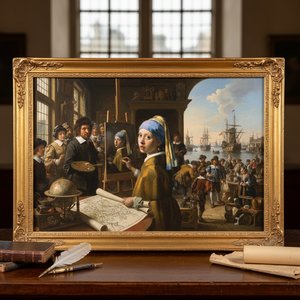
A Polish Exile’s Golden Hue: The Life and Art of Christoffel Lubienitzki
Christoffel Lubienitzki, a name that resonates softly through the annals of Baroque painting, embodies a fascinating intersection of cultural displacement and artistic flourishing. Born in 1659 in Szczecin, then part of Swedish Pomerania, his life was shaped by the turbulent religious landscape of Poland-Lithuania and found its mature expression amidst the vibrant artistic milieu of Amsterdam’s Golden Age. He wasn't merely a painter; he was a conduit between worlds, carrying with him the intellectual heritage of a persecuted Polish Protestant sect – the Polish Brethren – into the heart of Dutch artistry. His story is one of resilience, adaptation, and the enduring power of artistic vision. Lubienitzki’s family, steeped in nobility and scholarly pursuits, were forced to seek refuge from religious intolerance, a circumstance that would irrevocably alter their trajectory and ultimately contribute to the unique character of his work.From Hamburg Training to Amsterdam Apprenticeship
The early seeds of Lubienitzki’s artistic talent were sown in Hamburg, where he and his brother Teodor received instruction from Juriaan Stur, a landscape and seascape painter. This foundational training instilled within them an appreciation for natural observation and the subtleties of light – qualities that would later become hallmarks of their individual styles. However, it was the move to Amsterdam around 1667 that proved pivotal. Krzysztof entered the workshop of Adriaen Backer, a prominent portraitist known for his dramatic use of chiaroscuro and psychological depth. Simultaneously, Teodor apprenticed with Gerard de Lairesse, a leading figure in Dutch Classicism. This dual apprenticeship exposed the brothers to contrasting aesthetic approaches, shaping their artistic sensibilities and providing them with a broad technical foundation. While Backer’s influence is discernible in Lubienitzki's early portraits – particularly his mastery of texture and form – he ultimately forged his own path, blending Baroque grandeur with a distinctly Dutch sensibility for genre scenes and intimate portraiture.A Portraitist of Amsterdam Society
Lubienitzki quickly established himself as a sought-after portraitist in Amsterdam’s burgeoning art market. His patrons were diverse, reflecting the cosmopolitan nature of the city – merchants, poets, collectors, and members of the Remonstrant congregation, among whom he served as a deacon in 1681. His portraits are not merely likenesses; they are insightful studies of character, capturing the inner lives of his subjects with remarkable sensitivity. He possessed an exceptional ability to convey social status and personality through subtle details – the fall of light on a lace collar, the expression in the eyes, the carefully chosen props that hint at profession or intellectual pursuits. Works like *Portrait of Arnoud van Halen (1673-1732)* exemplify this skill, presenting a dignified yet approachable figure imbued with intelligence and refinement. Beyond portraiture, Lubienitzki demonstrated a keen interest in genre scenes, depicting everyday life with a meticulous attention to detail and a gentle humor. These paintings offer glimpses into the domestic interiors and social customs of 17th-century Amsterdam, revealing a world both familiar and subtly exotic.Collaboration and Legacy
Lubienitzki’s artistic endeavors extended beyond independent painting. He actively collaborated with leading printmakers of his time – Jacobus Houbraken, Daniël Willink, and Johannes Brandt (son of Gerard Brandt) – contributing designs for engravings that further disseminated his style and imagery. This collaborative spirit was characteristic of the Dutch art world, where artists often worked in partnership to meet the demands of a growing market. His brother Teodor’s eventual relocation to Hannover and then Poland did not diminish their artistic connection; they remained influential figures within their respective spheres. While Lubienitzki never returned to his homeland permanently, his Polish heritage continued to inform his work, subtly influencing his choice of subjects and his approach to composition. He died in Amsterdam in 1729, leaving behind a legacy of refined portraiture, engaging genre scenes, and a testament to the enduring power of art to transcend cultural boundaries. His *Portrait of a Young Man*, looted during World War II but later repatriated to Poland, stands as a poignant symbol of his life – a work that embodies both artistic excellence and the resilience of Polish identity in the face of adversity. His paintings continue to captivate viewers with their quiet dignity, technical mastery, and evocative portrayal of a bygone era. Lubienitzki’s contribution lies not only in his individual achievements but also in his ability to synthesize diverse artistic influences into a unique and compelling vision.问答详情
Christoffel Lubienitzki 的艺术生涯是如何划分为不同时期的?
Christoffel Lubienitzki 的艺术生涯在 艺术编年史 页面上按时期逐一展开:以横向时间轴的形式呈现作品,并按创作时期划分为不同的篇章。
Christoffel Lubienitzki 是否还有其他别名或曾用名?
Christoffel Lubienitzki 也被称为 Krzysztof Lubieniecki。
我可以通过色谱来探索 Christoffel Lubienitzki 的作品吗?
Christoffel Lubienitzki 的 色彩索引 是一个按色彩对艺术家作品进行分类整理的页面。