Cornelis Bisschop: A Life in Dutch Golden Age Painting
Early Life and Education
Cornelis Bisschop (February 12, 1630 – January 21, 1674) was a prominent painter of the Dutch Golden Age. Born in Dordrecht, Netherlands, he came from a family with artistic inclinations, foreshadowing the creative path he would pursue. Around 1650, Bisschop traveled to Amsterdam to study under the tutelage of Ferdinand Bol, a leading pupil of Rembrandt. This apprenticeship proved crucial in shaping his style and technique.
Artistic Development and Style
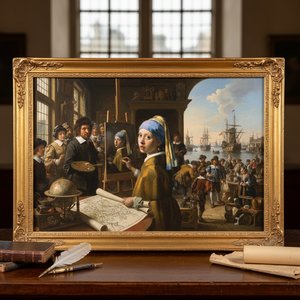
Bisschop’s artistic development was marked by versatility. He excelled in various genres including historical allegories, portraits, still lifes, and genre scenes. However, he is particularly celebrated for his mastery of trompe l'oeil – a technique that creates the illusion of three-dimensional reality on a two-dimensional surface. He became renowned as one of the first to paint carved wooden panels with such ingenuity, popularizing this style.
Key Works and Themes
- Allegory on the Raid on the Medway: A significant historical painting reflecting a contemporary event.
- Self-Portrait: Demonstrates his skill in portraiture and provides insight into his persona.
- Woman Peeling Apple: Exemplifies his talent for capturing everyday life with meticulous detail.
- A Young Woman and a Cavalier: Showcases his ability to portray figures within elegant settings.
His works often feature rich colors, dramatic lighting (influenced by Bol and Rembrandt), and a keen attention to texture and detail. Bisschop’s paintings frequently explore themes of morality, history, and the beauty of everyday life.
Influences and Legacy
Ferdinand Bol was undoubtedly the most significant influence on Bisschop's artistic style. He absorbed Bol’s use of chiaroscuro – the dramatic contrast between light and dark – and his compositional techniques. However, Bisschop developed a unique voice within this framework.
Bisschop’s legacy extends beyond his own paintings. He actively involved his children in his workshop, with two sons (Abraham and Jacobus) and three daughters becoming painters themselves. This familial artistic tradition ensured the continuation of his style and techniques.
Historical Significance
Cornelis Bisschop’s work provides valuable insight into 17th-century Dutch society, culture, and artistic tastes. His innovative use of trompe l'oeil pushed the boundaries of realism in painting, influencing subsequent generations of artists. Although he died unexpectedly at the age of 43, leaving behind a large family, his contributions to the Dutch Golden Age remain significant. He was even invited to paint for the Danish court, highlighting his international recognition.
问答详情
Cornelis Bisschop 出生于哪个国家?
Cornelis Bisschop 出生于 Netherlands。
目前目录中共有多少件 Cornelis Bisschop 的作品可供浏览?
您可以在 全部作品 页面浏览由 Cornelis Bisschop 创作的 44 件作品 件作品。
是否有Cornelis Bisschop作品的时间线?
您可以在Cornelis Bisschop的作品时间轴页面上按时间顺序查看其作品。