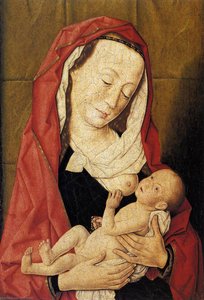
Dieric Bouts: The Silent Master of Early Netherlandish Painting
In the vibrant, bustling landscape of the fifteenth-century Netherlands, where the works of Jan van Eyck and Rogier van der Weyden dazzled with their dramatic flair and technical virtuosity, there existed a different kind of mastery. Dieric Bouts, often referred to as the "painter of silence," carved out a legacy not through theatrical emotion, but through a profound, meditative stillness. Born in Haarlem around 1415, Bouts emerged from the Northern Netherlands to become one of the most respected figures of the Early Netherlandish period. His life and work represent a unique intersection of technical innovation and spiritual introspection, offering a window into a world where every brushstroke served to deepen the viewer's contemplation of the divine.
The early years of Bouts’s journey are shrouded in the soft mists of history, yet his artistic lineage is clearly etched in the masterpieces he left behind. It is widely believed that he received formative training under the legendary Rogier van der Weyden, an influence that manifests in his meticulous attention to detail and a sophisticated command of color. However, Bouts was far from a mere imitator. While he inherited the Northern Renaissance's obsession with realism, he departed from the overt emotionalism of his peers. Instead, he developed a signature style characterized by a deliberate restraint and an almost architectural approach to composition. He possessed a singular ability to organize space, often utilizing a single vanishing point to create a sense of deep, structured perspective that was revolutionary for his time.
A Vision of Stillness and Sacred Space
Bouts’s career found its most significant expression in the city of Leuven, where he worked from at least 1457 until his death in 1475. His ascent within the local community was marked by great prestige; in 1468, he was appointed the official painter of the town, a testament to his standing among the civic and religious elite. This period saw the creation of some of his most enduring works, which often eschewed narrative chaos in favor of a carefully orchestrated solemnity. In his monumental altarpieces, such as The Last Supper, one does not find frantic gestures or weeping figures, but rather a quiet, heavy atmosphere that emphasizes the gravity of the sacred event through precise spatial relationships and balanced forms.
His technical prowess was particularly evident in his handling of light and texture. Whether working in tempera on panel or the burgeoning medium of oil, Bouts achieved a level of clarity that allowed the viewer to inhabit the scenes he created. His works often feature:
- Architectural Precision: A masterful use of geometric structures to frame religious narratives.
- Psychological Depth: Characters who appear lost in thought, inviting the viewer into a shared moment of prayerful reflection.
- Luminous Detail: An incredible ability to render the subtle textures of medieval clothing and the soft glow of divine light.
Legacy of the Flemish Primitive
The historical significance of Dieric Bouts lies in his role as a bridge between the foundational realism of the early Flemish masters and the more complex spatial explorations of the later Renaissance. By introducing a sense of mathematical order and a singular vanishing point into his compositions, he helped pave the way for future generations of painters to master the illusion of three-dimensional space on a flat surface. His ability to marry the spiritual with the structural ensured that his art was not merely a decoration, but a profound theological tool designed to inspire awe through clarity.
Though he may lack the flamboyant reputation of Van Eyck, Bouts remains an indispensable figure in the study of Northern Renaissance art. He taught us that power does not always require volume or noise; sometimes, the most profound truths are found in the quietest corners of a painting, held within the steady, unblinking gaze of a saint or the silent, structured shadows of a sacred hall. His life, spanning from the Netherlands to the heights of Leuven's artistic circles, remains a testament to the enduring strength of the contemplative spirit.
问答详情
如何浏览 Dierec Bouts 的全部作品?
您可以在 Dierec Bouts 的 全部作品 页面上浏览其在 本站 上的所有作品。
可以按媒介类型浏览 Dierec Bouts 的作品吗?
您可以在Dierec Bouts的所有媒介页面上按媒介浏览其作品。
在哪里可以按颜色分类查看Dierec Bouts的艺术作品?
色彩索引 页面按色彩对 Dierec Bouts 的作品进行了分类整理。