A Visionary of the Nazarene Spirit
Born in Vienna, Austria, Edward Jakob von Steinle emerged as a profound voice within the nineteenth-century art world, weaving together the spiritual depth of the Nazarene movement with a masterful command of both painting and printmaking. His artistic journey was deeply shaped by his formative years spent in Rome between 1828 and 1833, where he immersed himself among the leading figures of the Nazarene school. This period of intense study allowed him to absorb a philosophy that sought to revive sincerity and spiritual purity in Christian art, an influence that would remain the heartbeat of his creative output for decades to come.
As his career progressed, Steinle’s presence expanded far beyond the borders of his birthplace. While his roots remained firmly planted in the traditions of Vienna, he eventually settled in Frankfurt, Germany, where he became a central pillar of the German Romantic and Nazarene traditions. His ability to translate complex theological and literary themes into visual narratives made him a sought-after master for monumental commissions. From the delicate precision of his drawings to the grand scale of his frescoes, Steinle’s work often bridged the gap between the earthly and the divine.
Mastery of Sacred and Secular Narratives
The breadth of Steinle's talent is perhaps most evident in his ability to navigate both the sacred and the secular with equal grace. He was a master of monumental fresco and religious panel painting, leaving an indelible mark on the architectural landscape of Europe. His hands touched some of the most significant religious sites of his era, including:
- The Cologne Cathedral, where his contributions helped sustain the grandeur of Gothic tradition.
- The Strasbourg Minster, serving as a testament to his skill in large-scale ecclesiastical art.
- The chapel of Castle Rheineck, where his frescoes brought biblical stories to life through light and color.
- The Hall of the Emperors (Kaisersaal) in Frankfurt, showcasing his prowess in historical painting.
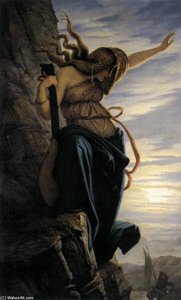
Beyond these grand religious cycles, Steinle also excelled in creating works that drew from the rich tapestry of literature and folklore. His depictions, such as those found in his interpretations of The Lorelei, demonstrate a captivating ability to capture the ethereal and the mysterious. Whether working with graphite, brush, and gray wash or executing intricate stained glass cartoons, his technique always served a higher purpose: to evoke emotion and invite contemplation.
Legacy and Artistic Significance
Steinle’s historical significance lies in his role as a bridge between eras. By championing the Nazarene ideals of spiritual revival, he helped maintain a sense of moral and aesthetic integrity during a period of rapid industrial and social change. His influence even extended to the next generation of great painters; notably, the renowned Frederic Leighton studied under him, carrying forward the lessons of classical form and expressive depth that Steinle had perfected.
Though his life concluded in Frankfurt, his artistic legacy remains etched in the very fabric of European cathedrals and museum collections. Through his dedication to the beauty of the sacred and the nuance of the human experience, Edward Jakob von Steinle ensured that the spirit of the Nazarene movement would endure as a vital chapter in the history of Western art.
问答详情
Edward Jakob Von Steinle 还以哪些名称为人所知?
Edward Jakob Von Steinle 也被称为 Eduard Von Steinle, Eduard Jakob Von Steinle, Steinle, Edward Von, Edward Jakob Von。
在哪里可以按色调浏览 Edward Jakob Von Steinle 的作品?
按色调分类 页面按色调将 Edward Jakob Von Steinle 的艺术作品进行了分类。
Edward Jakob Von Steinle 的创作时期属于哪个历史阶段?
Edward Jakob Von Steinle 的创作时期处于 19th Century 时期。这一时期确立了艺术家在历史中的地位。