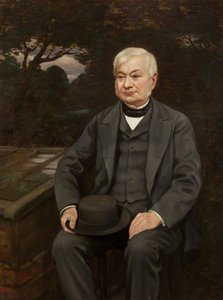
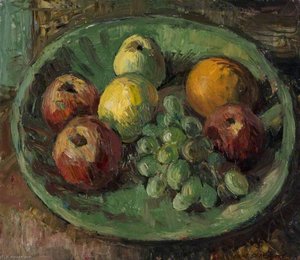
Elliott Seabrooke: A Painter of Light and Landscape
Elliott Seabrooke (1886-1950) emerges from the early 20th century as a quietly significant British painter, whose evocative landscapes and insightful still lifes offer a glimpse into a world both familiar and subtly transformed. Born in Upton Park, Essex – now part of London – his artistic journey was shaped by a confluence of influences: the rigorous training at the Slade School of Fine Art, a deep connection to the English countryside, and a period marked by significant social and political upheaval. Seabrooke’s work isn't characterized by flamboyant displays or radical experimentation; rather, it possesses a quiet dignity and an almost meditative quality, reflecting his own thoughtful nature and a profound appreciation for the natural world.Early Years and Artistic Foundations
Seabrooke’s early artistic development was rooted in traditional academic training at the Slade School of Fine Art from 1906 to 1911. Here, he encountered the teachings of Henry Tonks, a renowned figure who emphasized careful observation and technical skill. However, Seabrooke's artistic sensibilities quickly transcended mere imitation. He demonstrated an early inclination towards capturing light and atmosphere, drawing inspiration from the Impressionist movement – particularly the work of Cézanne’s emphasis on form and color—and later, the nascent principles of Pointillism, evident in his meticulous layering of small dots to create luminous effects. This fascination with light is a recurring motif throughout his oeuvre, suggesting an attempt to distill the essence of a scene rather than simply reproduce it visually.Wartime Service and Artistic Transformation
The First World War profoundly impacted Seabrooke’s life and artistic practice. Rejecting military service due to his pacifist beliefs, he instead dedicated himself to humanitarian work with the British Red Cross, serving on the Italian front. This experience proved transformative, exposing him to a different culture and broadening his perspective. It's during this period that he received Italy’s highest award for gallantry – a testament to his bravery and compassion. Crucially, it was also during the war that Seabrooke began experimenting with a more direct approach to color and form, influenced by the emerging theories of Seurat and Signac, incorporating these techniques into his landscapes.A Palette of English Landscapes
Following the war, Seabrooke established himself as a dedicated landscape painter, primarily focused on capturing the beauty of England’s diverse scenery. He spent considerable time in Epping Forest, the Lake District, and other rural areas, meticulously observing and translating these locations onto canvas. His paintings are characterized by a restrained palette—often dominated by muted greens, blues, and browns – creating a sense of atmospheric depth and tranquility. He wasn't interested in dramatic vistas or heroic compositions; instead, he sought to convey the subtle nuances of light, texture, and color that define the English countryside. Notable works such as “Landscape around Fingest, Buckinghamshire” exemplify this approach, presenting a serene and contemplative view of rolling hills bathed in soft light.Later Years and Legacy
In his later years, Seabrooke’s artistic practice continued to evolve, incorporating elements of Impressionism and Pointillism with a growing sensitivity to the changing social landscape. He remained active within the art world, serving as a Vice-President and then President of the Newnes Academy of Painters (NEAC), a prominent organization promoting contemporary British art. His work was exhibited widely, including at the Leicester Galleries and Matthiesen Gallery, and he even ventured into acting, demonstrating a multifaceted personality. Elliott Seabrooke’s legacy lies not in grand pronouncements or revolutionary techniques, but in his quietly compelling depictions of the English landscape—paintings that invite viewers to pause, reflect, and appreciate the beauty of the everyday world. His work is now held by institutions such as the Tate Gallery and the Arts Council, ensuring that this understated yet significant artist continues to be appreciated for generations to come.问答详情
Elliot Seabrooke 的作品受欢迎程度如何?
Elliot Seabrooke 拥有一个 统计数据 页面,其中展示了该艺术家在 本站 上的作品统计数据。
如何浏览 Elliot Seabrooke 的全部作品?
您可以在 Elliot Seabrooke 的 全部作品 页面上浏览其在 本站 上的所有作品。
Elliot Seabrooke 出生于何时何地?
Elliot Seabrooke 于 1886 出生于 London Borough of Newham。