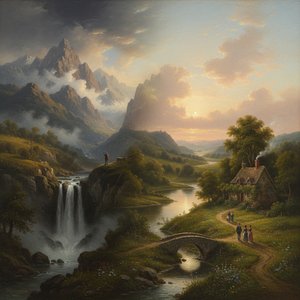
Eugenio Landesio: Bridging Romantic Idealism and Scientific Observation
The story of Eugenio Landesio is one of profound movement, a journey that began in the quiet landscapes of Northern Italy and culminated in the transformative heart of Mexican art history. Born in 1810 in Altessano, near Turin, Landesio was destined for a life defined by precision and beauty. Raised within a family of skilled silversmiths, his earliest encounters with art were rooted in the meticulous craftsmanship of metalwork. This foundational exposure to fine detail and structural integrity would later become a hallmark of his painting style, where the delicate touch of a Romanticist met the exacting eye of a scientist.
His artistic evolution was shaped by the masters of Europe. After demonstrating an undeniable talent for drawing that compelled even his father to support his passion, Landesio sought formal training under the French painter Amédée Bourgeois. However, it was his apprenticeship with the Hungarian Romantic master Károly Markó the Elder that truly forged his aesthetic identity. From Markó, Landesio inherited a deep reverence for the sublime—the ability to capture nature not just as a physical space, but as an emotional experience. Yet, where others might have settled for mere atmosphere, Landesio sought truth through observation, blending the sweeping, emotive vistas of Romanticism with a rigorous commitment to botanical and geological accuracy.
A Transformative Arrival in Mexico
In 1855, the trajectory of Landesio’s life—and indeed, the course of Mexican art—underwent a seismic shift. Invited to Mexico by Pelegrín Clavé, the director of the Academy of San Carlos, Landesio arrived in a nation eager for new artistic perspectives. He did not merely arrive as a painter, but as a scholar and educator. Settling into the vibrant cultural landscape of Mexico, he became a cornerstone of the Academy, where his teachings on perspective, ornamentation, and landscape composition would leave an indelible mark on generations of students.
His pedagogical legacy is preserved in his influential textbooks, works that served as the very foundation for aspiring Mexican artists. Through titles such as Los Cimientos del Artista Dibujante y Pintor and his detailed accounts of geological excursions to the Popocatépetl crater, Landesio bridged the gap between art and science. He taught his pupils to see the landscape through a dual lens: appreciating its poetic grandeur while respecting its structural and biological reality. This rigorous approach provided the technical scaffolding upon which much of 19th-century Mexican landscape painting was built.
Legacy and Historical Significance
The historical significance of Eugenio Landesio lies in his role as a vital link between European traditions and the emergence of a distinct Mexican national identity in art. While his roots were Italian and his training Hungarian, his soul became inextricably linked to the Mexican terrain. He did not simply paint foreign landscapes; he taught Mexican artists how to observe their own land with a new level of scientific sophistication and Romantic wonder.
His influence is most palpably felt in the work of the legendary José María Velasco, whose monumental landscapes owe much to the principles of perspective and naturalism instilled by Landesio. The artist's oeuvre remains a testament to a unique period of transition, characterized by:
- The Synthesis of Styles: A rare ability to harmonize the emotional depth of Romanticism with the precision of scientific illustration.
- Educational Impact: The establishment of formal landscape and perspective methodologies at the Academy of San Carlos.
- Botanical and Geological Detail: An unwavering dedication to documenting the natural world, from monochrome ink studies to sweeping oil canvases.
- Cultural Integration: The successful transplantation of European academic rigor into the burgeoning artistic scene of 19th-century Mexico.
Today, when we look upon his works—whether they be dramatic industrial scenes like Minas de Real del Monte or delicate botanical studies—we see more than just paint on canvas. We see the legacy of a man who taught us that to truly love nature, one must first seek to understand its deepest, most intricate truths.
问答详情
在哪里可以按颜色分类查看Eugenio Landesio的艺术作品?
Eugenio Landesio 的 色彩索引 是一个按色彩对艺术家作品进行分类整理的页面。
在哪里可以找到关于Eugenio Landesio作品的相关统计数据?
关于 Eugenio Landesio 作品的相关统计数据,请参阅艺术家的 访问统计 页面。
在哪里可以按技法分类浏览 Eugenio Landesio 的作品?
您可以在Eugenio Landesio的全部媒介页面上按媒介浏览其作品。