Frederick Nash: A Painter of English Light and Shadow
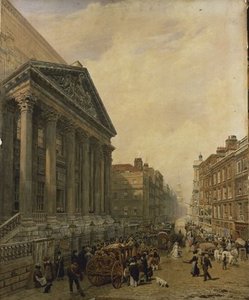
Frederick Nash (1782–1856) stands as a significant, yet often understated, figure in 19th-century British art. Born in Lambeth, London, into a family with roots in building, his early life was marked by an exposure to both the practicalities of construction and the burgeoning world of artistic patronage. Initially drawn to architectural drawing under the tutelage of Thomas Malton the younger, Nash’s trajectory shifted towards landscape painting, propelled by a keen eye for light, color, and the subtle nuances of English countryside. His career spanned several decades, encompassing a diverse range of subjects – from grand architectural vistas to intimate scenes of rural life, Parisian glimpses, and meticulously rendered studies of classical ruins – all executed with a distinctive sensitivity and technical skill.
Nash’s artistic journey began within the framework of the Society of Painters in Watercolours, an organization formed in 1809 by artists who felt marginalized by the more conservative Royal Academy. This secession proved pivotal, providing Nash with a platform to develop his own style and explore themes that resonated with his artistic vision. His early works were heavily influenced by the Neoclassical tradition, evident in his detailed depictions of Westminster Abbey and other iconic landmarks. However, as he matured, Nash’s palette became increasingly vibrant, embracing the Romantic sensibility and capturing the fleeting effects of light and atmosphere with remarkable precision. He was a master of ‘plein air’ painting, often venturing into the countryside to directly observe and record the changing conditions of nature.
A Journey Through Landscapes and Cities
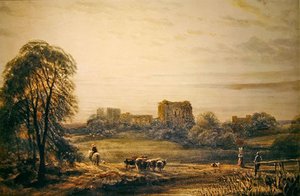
Nash's artistic output can be broadly categorized into several distinct phases. His early years were dominated by architectural drawings for Britton and Brayley, providing him with invaluable experience in draughtsmanship and a deep appreciation for historical buildings. The series of views he produced for the ‘Vetusta Monumenta’ – meticulously detailed depictions of abbeys and cathedrals across England – established his reputation as a skilled observer and recorder of the past. These works were not merely reproductions; Nash imbued them with a sense of atmosphere and history, capturing the essence of each location.
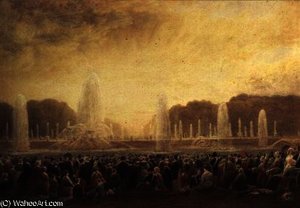
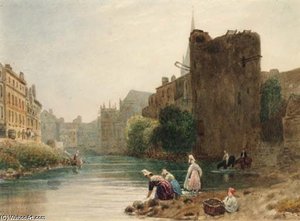
As he moved into the 1820s and 30s, Nash’s focus shifted towards landscape painting. His trips to Calais, Caen, the Moselle river, and the Rhine resulted in a series of evocative scenes that showcased his ability to capture the beauty of European scenery. He also spent considerable time in Paris, producing charming depictions of the city's boulevards, cafes, and gardens – works that offer a valuable glimpse into Parisian life during this period. Notably, he was commissioned by Sir Thomas Lawrence to paint portraits of the French royal family, demonstrating his versatility as an artist.
Technique and Style
Nash’s technical skill is immediately apparent in his paintings. He possessed a remarkable ability to render light with astonishing accuracy, capturing its subtle shifts and reflections on surfaces. His brushwork was typically loose and expressive, yet always controlled and deliberate. He favored watercolor as his primary medium, skillfully layering washes of color to create depth and atmosphere. While influenced by the Romantic movement’s emphasis on emotion and subjectivity, Nash maintained a rigorous attention to detail and a commitment to realistic representation. He wasn't simply painting what he *saw*, but rather what he *felt* about what he saw – imbuing his landscapes with a sense of quiet contemplation and understated beauty.
Legacy and Historical Significance
Frederick Nash’s contribution to British art is often overlooked, overshadowed by the more celebrated figures of Turner and Constable. However, his meticulous observation, technical skill, and sensitive portrayal of English landscape and urban life deserve recognition. His work provides a valuable record of 19th-century England, capturing both its grandeur and its quiet beauty. His paintings are housed in several major collections, including the National Gallery and the Tate Britain, testament to their enduring appeal. Nash’s legacy lies not only in his individual works but also in his role as a pioneer of watercolor painting and a keen observer of the changing world around him.
问答详情
我可以通过色谱来探索 Frederick Nash 的作品吗?
色彩索引 页面按色彩对 Frederick Nash 的作品进行了分类整理。
我可以通过关键词来探索 Frederick Nash 的作品吗?
您可以通过艺术家关键词分类页面,按关键词探索Frederick Nash的作品。每个关键词都汇集了相关的艺术品。
Frederick Nash 的创作时期属于哪个历史阶段?
Frederick Nash 的创作活跃于 19th Century 时期,这一时期确立了艺术家在艺术史上的地位。