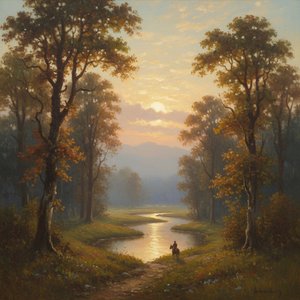
Georg Janny: Weaver of Alpine Dreams and Mythic Landscapes
The Austrian artist Georg Janny (1864-1935) wasn’t a name etched into the annals of art history during his lifetime, yet his evocative paintings—particularly those depicting the majestic Alps and populated with fantastical creatures—hold a quiet power. Born in Vienna, Janny's artistic journey began not in a formal academy but within the bustling workshops of Brioschi, Burghart, and Kautsky, renowned for their theatrical scenery design for the prestigious Vienna State Opera. This early apprenticeship profoundly shaped his visual language, instilling a deep understanding of composition, color theory, and the dramatic interplay of light and shadow—skills that would later inform his captivating landscapes.
Janny’s initial role was as a scene painter, contributing to lavish productions like the iconic “Iron Curtain” commemorating Emperor Franz Joseph I's golden jubilee in 1898. This experience exposed him to the demands of large-scale painting and the collaborative nature of theatrical design. However, it was during this period that his artistic sensibilities truly began to flourish. He quickly evolved beyond mere decoration, developing a distinctive style characterized by atmospheric perspective, meticulous detail, and an almost dreamlike quality. His work wasn’t simply about depicting mountains; it was about capturing their essence—their grandeur, their solitude, and the sense of timelessness they evoke.
A World Beyond Reality: The Influence of Fairy Tales and Mythology
What truly distinguishes Janny's oeuvre is his infusion of folklore and mythology into his landscapes. While rooted in meticulous observation of the Austrian Alps—from the dramatic peaks of the Sella Group to the serene shores of Lake Pisciadu—his paintings frequently feature elements that transcend the purely representational. Fairies, elves, and other mythical beings subtly emerge from the rocky terrain, adding a layer of enchantment and hinting at hidden worlds beneath the surface. This wasn’t an attempt to create overtly fantastical scenes; rather, Janny seemed to believe that these creatures were already present in the landscape, waiting to be revealed by a discerning eye.
This fascination with folklore likely stemmed from his exposure to the rich artistic traditions of Vienna and his own imaginative spirit. He drew inspiration from artists like Arnold Böcklin, whose evocative Symbolist paintings explored themes of mystery and the supernatural, as well as Gustave Doré, known for his detailed illustrations of fairy tales and biblical stories. Janny’s work can be seen as a continuation of this tradition—a visual exploration of the intersection between reality and imagination.
Technique and Style: Watercolor's Delicate Embrace
Janny primarily worked in watercolor, a medium that perfectly suited his delicate style and atmospheric approach. The transparency of watercolor allowed him to build up layers of color gradually, creating subtle gradations of tone and light—essential for capturing the ethereal quality of the Alpine landscape. His brushwork is often loose and expressive, conveying a sense of movement and spontaneity. He skillfully employed techniques such as wet-on-wet washes to create soft, diffused effects, particularly in his depictions of clouds and mist.
Despite the inherent challenges of watercolor—its tendency to bleed and its difficulty in achieving sharp detail—Janny mastered the medium with remarkable precision. His paintings are not simply renderings of landscapes; they are carefully constructed compositions that invite the viewer to lose themselves in their beauty and mystery. The use of muted, earthy tones—greens, browns, grays, and blues—further enhances the sense of atmosphere and creates a feeling of quiet contemplation.
Legacy and Recognition
While Janny’s work didn't achieve widespread fame during his lifetime, it has since been recognized for its unique charm and artistic merit. His paintings are now housed in museums and private collections throughout Austria and beyond, offering a glimpse into the world of a talented artist who dedicated his life to capturing the beauty and mystery of the Alpine landscape. The Bezirksmuseum Hernals in Vienna holds a significant collection of his works, providing valuable insights into his creative process and artistic vision.
Janny’s legacy lies not only in his individual paintings but also in their contribution to the broader tradition of landscape art—a tradition that continues to inspire artists today. His ability to seamlessly blend observation with imagination, realism with fantasy, solidifies his place as a significant figure in Austrian art history, a quiet master of Alpine dreams.
问答详情
如何按特定主题查找 Georg Janny 的作品?
若要按特定主题查找 Georg Janny 的作品,请访问艺术家的 关键词分类 页面,该页面通过关键词对作品进行了分类整理。
Georg Janny 最常使用的色彩有哪些?
Georg Janny 作品的色彩特征展示在艺术家的 色彩基因 页面上。
Georg Janny 的作品传达了怎样的情绪?
艺术家的 情境空间 页面按氛围分类展示了 Georg Janny 的艺术作品。