The Serene Vision of Giovanni Battista Cimaroli
In the golden age of the Venetian Republic, amidst the shimmering canals and the sprawling pastoral beauty of the Veneto, lived an artist whose brush captured the very soul of the Italian landscape. Giovanni Battista Cimaroli (1687–1771) was not merely a painter of scenery, but a chronicler of tranquility. Born in Salò, on the scenic shores of Lake Garda, Cimaroli emerged from a lineage of artistic discipline; his father was a sculptor, a fact that likely instilled in him a profound respect for form and structure. His early training under Antonio Aureggio provided a rigorous foundation in disegno, while his subsequent journey to Bologna to study with Antonio Calza refined his ability to manipulate light and perspective. By the time he established himself in Venice around 1713, Cimaroli had developed a voice that was uniquely his own—a blend of meticulous observation and an idealized, Arcadian grace.
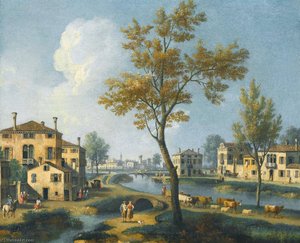
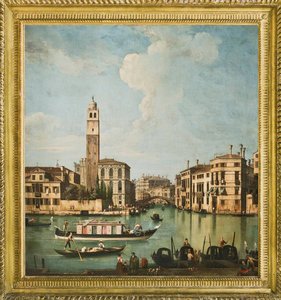
Cimaroli’s work serves as a window into an era defined by the pursuit of pastoral perfection. His compositions often feature the rustic charm of the Venetian countryside, populated by graceful figures, wandering cattle, and the weathered ruins of antiquity. He was deeply influenced by the masters of his time, most notably Francesco Zuccarelli and Canaletto. From Zuccarelli, he inherited a penchant for the Arcadian ideal—the creation of landscapes that felt both natural and poetically composed. From Canaletto, he drew an appreciation for topographical accuracy and the subtle atmospheric effects that define the Venetian sky. This synthesis allowed him to create scenes that were simultaneously grounded in reality and elevated by a sense of timelessness.
Mastery of Light and the Brenta Series
The technical brilliance of Cimaroli lies in his ability to evoke atmosphere through texture and tone. He was a master of thick impasto, using a heavy layering of paint to breathe life into the foliage of trees and the rugged surfaces of stone ruins. This tactile approach creates a palpable sense of physicality, making the lush greenery and flowing waters of his landscapes feel almost touchable. His ability to modulate light allowed him to capture the fleeting moments of a Venetian afternoon—the way sunlight filters through a canopy or reflects off the surface of a quiet canal.
One of his most significant artistic achievements was his involvement in the Brenta Landscape Series (c. 1723-1726). Created at the invitation of Canaletto, this ambitious project offered panoramic views of the Brenta River near Dolo. These works represent a pinnacle of Venetian topographical painting, showcasing Cimaroli’s ability to document the dynamism of the region—from horses hauling carts to boats navigating the river—while maintaining a sense of profound peace. Through these vistas, he captured a world of everyday life that, while vibrant, remained anchored in a serene, almost dreamlike state.
A Legacy of Venetian Tranquility
Though history has sometimes overlooked Cimaroli in favor of his more famous contemporaries, his significance within the Italian Baroque and Rococo traditions remains undeniable. His reputation for meticulous rendering earned him the patronage of influential figures such as Marshal Schulenberg and Count Tessin. Perhaps most telling of his skill was his collaboration with Canaletto on the ambitious tomb series for Owen McSwiney, a project intended to honor British statesmen through the lens of Italian mastery.
Today, Cimaroli’s oeuvre stands as a testament to the enduring allure of the Veneto landscape. His paintings are more than mere depictions of farms, villas, and ruins; they are emotional landscapes that invite the viewer to step into a world of harmony and balance. As we look upon his sweeping riverbanks and quiet pastoral scenes, we find a lasting legacy of beauty that continues to resonate with the human desire for peace and the eternal charm of the natural world.
问答详情
在哪里可以按主题查看Giovanni Battista Cimaroli的作品分布?
您可以在Giovanni Battista Cimaroli的主题索引页面上,按主题探索其作品。
在哪里可以按颜色分类查看Giovanni Battista Cimaroli的艺术作品?
色彩索引 页面按色彩对 Giovanni Battista Cimaroli 的作品进行了分类整理。
Giovanni Battista Cimaroli 的艺术风格是如何随时间演变的?
您可以在艺术家的 艺术历程 页面上查阅 Giovanni Battista Cimaroli 作品的编年史,其作品按创作顺序分章节依次呈现。