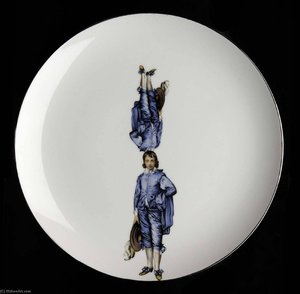
Howard Kottler: A Satirical Voice in Ceramic Art
Howard Kottler (1930-1989) stands as a pivotal, yet often underappreciated, figure in the evolution of American ceramics and conceptual art. His work, characterized by its playful irreverence and sharp critique of popular culture, challenged conventional notions of what ceramic art could be. Born in Cleveland, Ohio, Kottler’s journey from an initial interest in biology to becoming a celebrated artist was marked by a profound shift – a passionate embrace of clay as a powerful medium for social commentary. His career unfolded primarily within the vibrant artistic landscape of Seattle, Washington, where he taught at the University of Washington for over two decades and established himself as a key voice in the burgeoning Funk art movement.Early Influences and Artistic Training
Kottler’s initial exposure to ceramics came unexpectedly during his undergraduate studies at Ohio State University in 1952, sparking a lifelong fascination with the material's versatility. This early interest was solidified through formal training – earning an M.A. in Ceramics (1956) and subsequently a Ph.D. in 1964. Crucially, his education extended beyond traditional techniques; he sought out experiences that broadened his artistic horizons. A Fulbright grant enabled him to study at the Central School of Arts and Crafts in London and the Arabia Ceramic Factory in Finland, immersing himself in the world of decal application – a technique he would later master and transform into a defining element of his unique style. His time with Kyllikki Salmenhaara, a renowned Finnish potter, proved particularly influential, shaping his understanding of clay’s potential for both decorative and conceptual expression. The influence of Maija Grotell at Cranbrook Academy of Art further cemented his approach to art as an exploration of process and meaning.The Development of ‘Decalomania’
Kottler's artistic breakthrough came through his innovative use of commercially produced porcelain plates and decals. Rejecting the traditional emphasis on hand-crafted perfection, he embraced mass production and appropriated images from advertising, magazines, and popular culture – transforming these everyday objects into satirical statements. This approach, often referred to as “decalomania,” became the cornerstone of his artistic practice. He meticulously selected images—often deliberately clashing or incongruous—and applied them to ceramic surfaces, creating layered narratives that critiqued consumerism, media saturation, and the superficiality of contemporary life. His work wasn’t simply decoration; it was a deliberate provocation, forcing viewers to confront the ubiquity of imagery in their daily lives. The use of gold paint added another layer of complexity, elevating these commonplace objects into works of art while simultaneously highlighting their artificiality.Key Works and Artistic Style
Several pieces exemplify Kottler’s distinctive style and thematic concerns. “Chalice” (1965), a vibrant ceramic vase blending bold blues and yellows, showcases his masterful use of color and imagery. "Waiting for Master" (1986) is a testament to his playful approach, depicting a dog in gold paint, evoking a sense of anticipation and perhaps even longing. His work frequently incorporated text alongside images, creating complex layers of meaning that demanded careful interpretation. Kottler’s pieces are not easily categorized; they blend elements of Funk art, Pop Art, and conceptual art, reflecting his eclectic influences and his desire to challenge artistic conventions. The Seattle Art Museum Collection holds a significant body of his work, offering a comprehensive overview of his artistic trajectory.Legacy and Historical Significance
Howard Kottler’s impact on contemporary ceramics is undeniable. He pushed the boundaries of the medium, demonstrating that ceramic art could be both visually engaging and intellectually stimulating. His embrace of mass-produced materials and appropriation techniques paved the way for subsequent generations of artists who explored themes of consumer culture and media influence. While his work was not always immediately recognized during his lifetime, it has since gained considerable critical acclaim, with retrospectives at major museums across the United States and Europe solidifying his place as a seminal figure in American art history. Kottler’s legacy lies not only in his distinctive aesthetic but also in his courageous willingness to question established artistic norms and use ceramics as a vehicle for social commentary – a voice that continues to resonate today.问答详情
Howard Kottler 的艺术风格是如何随时间演变的?
您可以在艺术家的 艺术历程 页面上查阅 Howard Kottler 作品的编年史,其作品按创作顺序分章节依次呈现。
如何按年份顺序浏览 Howard Kottler 的作品?
Howard Kottler 的作品时间轴现已上线:在艺术家的 作品时间轴 页面中,所有作品均按创作日期排序。
我可以通过主题来探索 Howard Kottler 的作品吗?
Howard Kottler 的 主题索引 旨在通过主题对艺术家的作品进行分类索引。