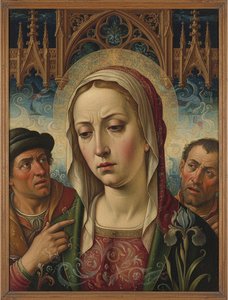
A Life Immersed in Portraiture: The World of Hugo Boettinger
Hugo Boettinger, born in Prague in 1880 and passing away in 1934, was a Czech painter whose name resonates within the annals of early 20th-century portraiture. While not as widely celebrated internationally as some of his contemporaries, Boettinger carved a distinctive niche for himself through an unwavering dedication to capturing the essence of his subjects – particularly those within Prague’s vibrant artistic and intellectual circles. His life, though relatively undocumented in exhaustive detail, was one deeply interwoven with the cultural currents of Bohemia during a period of significant social and political change. He received his foundational training at the Prague School of Arts and Crafts in 1895, later transferring to the Academy of Fine Arts in the same city in 1899. This formal education provided him with the technical skills that would become hallmarks of his mature style: a meticulous attention to detail, a refined understanding of light and shadow, and an ability to render textures with remarkable realism. However, Boettinger’s artistic journey wasn't confined to the studio; beginning in 1902, he embarked on extensive travels throughout Europe – Paris, London, the Netherlands, Belgium, and Germany – absorbing diverse influences that would subtly shape his aesthetic vision.The Development of a Unique Style
Boettinger’s early work demonstrates a clear grounding in classical portraiture traditions. He possessed an exceptional talent for capturing likenesses, but he wasn't content with mere replication. His paintings gradually evolved to incorporate a psychological depth and emotional nuance that set him apart. He moved beyond simply depicting outward appearances; he sought to reveal the inner lives of his sitters through subtle gestures, expressive eyes, and carefully chosen compositions. This pursuit led him towards a style characterized by a restrained elegance and a quiet intensity. He became particularly adept at portraying women, often focusing on members of Prague’s artistic community. His most iconic work arguably features Milča Mayerová, a celebrated actress and muse whose portraits by Boettinger are considered masterpieces of Czech portraiture. These paintings aren't simply representations of a beautiful woman; they offer intimate glimpses into her personality, intelligence, and spirit. The influence of Symbolism can be detected in some of his works, though he never fully embraced the movement’s more overtly fantastical elements. Instead, he used symbolic details sparingly, employing them to subtly enhance the psychological impact of his portraits.Key Works and Artistic Achievements
While a comprehensive catalogue raisonné of Boettinger's work remains elusive, several paintings stand out as exemplars of his artistic achievements. The series of portraits depicting Milča Mayerová are undoubtedly central to his legacy. These works showcase his mastery of oil paint, his ability to capture the play of light on skin and fabric, and his profound sensitivity to human emotion. Beyond these iconic images, Boettinger created a substantial body of work that included portraits of other prominent figures in Czech society – writers, musicians, and artists. He also explored genre scenes and landscapes, though portraiture remained his primary focus throughout his career. His paintings were exhibited regularly in Prague and other European cities, earning him recognition within the local art scene. In 1907, he became a member of the Hagenbund, an influential Austrian artist association known for its progressive outlook and its embrace of modern artistic trends. He was also inducted into the Czech Academy of Sciences and Arts, further solidifying his position as a respected figure in the cultural landscape.Boettinger’s Place in History
Hugo Boettinger's historical significance lies not in radical innovation or groundbreaking stylistic departures, but rather in his refined mastery of portraiture and his ability to capture the spirit of an era. He represents a bridge between the classical traditions of 19th-century painting and the emerging modern sensibilities of the early 20th century. His work offers valuable insights into the social and cultural life of Prague during a period of rapid change, providing glimpses into the lives of individuals who shaped the city’s artistic landscape. He was known as Dr. Desiderius in some circles, hinting at broader intellectual pursuits beyond his artistic endeavors. While perhaps overshadowed by more internationally renowned artists, Boettinger's paintings continue to captivate viewers with their quiet elegance, psychological depth, and enduring beauty. His legacy endures as a testament to the power of portraiture to reveal not just outward appearances, but also the inner lives of those who grace the canvas.问答详情
可以按媒介类型浏览 Hugo Boettinger 的作品吗?
若要查找Hugo Boettinger在特定媒介下的所有作品,请访问艺术家的所有媒介页面。
我可以通过艺术流派来浏览 Hugo Boettinger 的作品吗?
您可以在Hugo Boettinger的全部流派页面上,按艺术流派浏览其作品。
在哪里可以按色调浏览 Hugo Boettinger 的作品?
您可以在Hugo Boettinger的按色调浏览页面上,按色调浏览其作品。