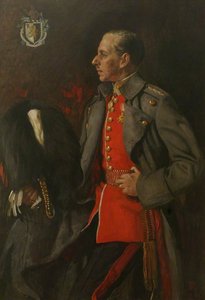
The Luminous Legacy of Isaac Michael Cohen
Isaac Michael Cohen (1884–1951) stands as a profound bridge between the rugged, untamed landscapes of the Australian frontier and the refined, academic elegance of the European tradition. Born in Ballarat, Victoria—a city forged in the heat of the Australian gold rush—Cohen’s early life was steeped in an environment of grit and natural splendor. The vast, sweeping vistas of the Victorian bushland served as his first classroom, instilling in him a lifelong reverence for the interplay of light and shadow upon the earth. This primal connection to the Australian wilderness would later find a sophisticated voice through his rigorous formal training, beginning at the Ballarat Technical School and advancing to the National Gallery of Victoria School.
The trajectory of Cohen’s career was irrevocably altered by a prestigious travelling scholarship, an opportunity that whisked him away from the Southern Hemisphere to the heart of the global art scene in Paris. It was within the hallowed halls of the École Supérieure des Beaux-Arts that Cohen truly found his artistic soul. Immersed in the vibrant atmosphere of the French capital, he encountered the revolutionary currents of Impressionism and Post-Impramssionism. The works of masters such as Claude Monet and Paul Cézanne offered him a new vocabulary of light and form, teaching him to move beyond mere academic realism toward a more emotive, atmospheric way of seeing. This Parisian engagement infused his technique with a distinctive luminosity and a subtle mastery of texture that would become his hallmark.
A Mastery of Portraiture and Place
As Cohen’s style matured, he achieved a rare equilibrium between the meticulous precision of traditional portraiture and the fluid, expressive qualities of modernism. His canvases became windows into the human condition, capturing prominent figures of Victorian society with an intimacy that felt both timeless and deeply personal. He possessed a singular ability to place his subjects in contemplative, quiet moments, often utilizing atmospheric perspective—a technique perfected during his French studies—to create depth and a sense of psychological space. His portraits were not merely likenesses but explorations of character, rendered with a command of tonal gradation that breathed life into every brushstroke.
Beyond the studio, Cohen’s work remained anchored to the landscapes that shaped him. His ability to translate the essence of the Australian wilderness through a European lens allowed him to present the bushland not just as a geographical location, but as an emotional landscape. This duality is perhaps best seen in his notable commissions and exhibition history:
- The Portrait of Anne Dalrymple Champneys: A celebrated work depicting the renowned philanthropist, showcasing Cohen's ability to capture grace and social stature.
- Sir Charles Thomas Stanford: A masterful depiction of the composer in academic robes, demonstrating his skill with complex textures and formal composition.
- The Exploration of Light: His landscapes that utilized luminous color palettes to evoke the unique, harsh yet beautiful light of the Australian continent.
Historical Significance and Artistic Endurance
Throughout his decades-long career, Cohen’s presence was felt in the most prestigious art circles, with exhibitions at the Royal Academy (RA), the Royal Institute of Oil Painters (ROI), and the Salon in Paris. These accolades cemented his reputation as an artist of international caliber, capable of navigating the transition from late-nineteenth-century academicism to the burgeoning modern era. His work serves as a vital historical record, capturing the faces and the landscapes of a transformative period in both Australian and European history.
Today, the legacy of Isaac Michael Cohen lives on through his contributions to public collections and the enduring emotional resonance of his paintings. He remains a significant figure for those seeking to understand the dialogue between colonial identity and cosmopolitan influence. His ability to weave together the ruggedness of his Australian origins with the sophisticated light of Paris ensures that his art continues to captivate, offering a timeless meditation on memory, place, and the enduring power of the human gaze.
问答详情
Isaac Michael Cohen 还有哪些别名?
Isaac Michael Cohen 也以 I.M. Cohen 等其他名称为人所知。
在哪里可以按技法分类浏览 Isaac Michael Cohen 的作品?
所有媒介 页面按媒介分类展示了 Isaac Michael Cohen 的作品。
在哪里可以按时间顺序欣赏 Isaac Michael Cohen 的作品?
Isaac Michael Cohen 的作品时间轴现已上线:在艺术家的 作品时间轴 页面中,所有作品均按创作日期排序。