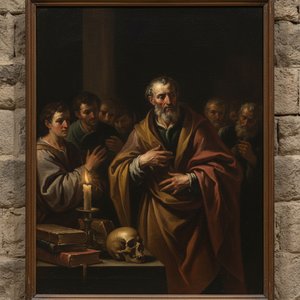
The Architect of Royal Splendor
Isidro González Velázquez stands as a pivotal figure in the grand tapestry of Spanish architecture, embodying the enduring legacy of one of Spain's most illustrious artistic dynasties. Born in Madrid in 1765, his very existence was steeped in the pursuit of aesthetic excellence. He was born into a lineage where art was not merely a profession but a family vocation; his father, Antonio González Velázquez, was a celebrated painter serving Charles III, while his grandfather Pablo and uncles Luis and Alejandro were equally renowned sculptors and painters. This environment, rich with the whispers of creative mastery, profoundly shaped Isidro’s trajectory, instilling in him a unique sensitivity that bridged the gap between the structural precision of an architect and the delicate draughtsmanship of an engraver.
His formal journey into the heart of Spanish Neoclassicism began at the prestigious Real Academia de Bellas Artes de San Fernando in Madrid. It was within these hallowed halls that he studied under the guidance of Mariano Salvador Domínguez Berruguete, a mentor who helped him navigate the transition from the lingering grandeur of Baroque ornamentation to the disciplined elegance of Neoclassical design. This period of rigorous training allowed him to master the technical complexities of architectural drafting while retaining an eye for the dramatic flourishes that defined his era. His talent for fine lines and detailed compositions—a gift inherited from his father—ensured that his architectural visions were as much about visual storytelling as they were about structural integrity.
A Legacy of Royal Patronage
The ascent of González Velázquez through the academic and royal hierarchies was nothing short of meteoric. His dedication to the craft led him to secure a prestigious position as Deputy Director of Painting in 1804, eventually reaching the pinnacle of academic influence when he was appointed Director of the Academy in 1828. This role was not merely administrative; it was a position of profound cultural stewardship. As an advisor to King Ferdinand VII, Isidro became a central figure in overseeing royal commissions that would define the visual identity of the Spanish monarchy during a period of significant political transition.
His work often transcended the boundaries of mere construction, as he frequently engaged in the intricate decoration of royal spaces. His contributions helped cement his reputation as a master craftsman capable of harmonizing large-scale architectural projects with the fine details of interior ornamentation. Through his leadership at the Academy, he actively shaped the aesthetic sensibilities of the early 19 century, advocating for a stylistic coherence that upheld the highest standards of Spanish excellence. His life’s work serves as a bridge between the opulent traditions of the late Baroque and the structured refinement of the Neoclassical movement.
Artistic Contributions and Historical Significance
The historical significance of Isidro González Velázquez lies in his ability to maintain the continuity of Spanish artistic tradition during an era of profound change. While much of Europe was grappling with the seismic shifts brought about by the Napoleonic Wars, Isidro remained a steadfast guardian of the Academy's standards. His work reflects a deep commitment to the following elements:
- Architectural Synthesis: The seamless integration of Neoclassical order with the decorative richness of the late Baroque style.
- Academic Leadership: His transformative role as Director of the Real Academia de Bellas Artes de San Fernando, where he mentored future generations of Spanish artists.
- Royal Service: The execution of monumental commissions that decorated the royal residences and solidified the prestige of the Spanish Crown.
- Technical Mastery: A rare ability to combine the structural demands of architecture with the expressive potential of engraving and draughtsmanship.
Though his life concluded in Madrid in 1831, the echoes of his architectural vision remain etched into the historical fabric of Spain. He was more than an architect; he was a custodian of beauty, ensuring that the grandeur of the Spanish Golden Age evolved gracefully into the modern era. His name remains inextricably linked to the very soul of Madrid's artistic heritage, representing a period when art and architecture combined to create a lasting monument to royal splendor.
问答详情
如何按特定主题查找 Isidro González Velázquez 的作品?
若要按特定主题查找 Isidro González Velázquez 的作品,请访问艺术家的 关键词分类 页面,该页面通过关键词对作品进行了分类整理。
Isidro González Velázquez 最常使用的色彩有哪些?
Isidro González Velázquez 作品的色彩特征展示在艺术家的 色彩基因 页面上。
可以按心情浏览 Isidro González Velázquez 的作品吗?
您可以在艺术家 Isidro González Velázquez 的 情境空间 页面上按心情浏览其作品,该页面已根据作品所传达的情绪进行了分类整理。