Jacobus Vrel: The Shadow Painter Who Illuminated Vermeer’s Legacy
Jacobus Vrel (c. 1617 – 1681) remains an artist shrouded in mystery, a figure whose brilliance was largely eclipsed by the towering presence of Johannes Vermeer during his lifetime and subsequently overshadowed by scholarly debates about his artistic lineage. Despite the initial confusion surrounding his identity—often mistaken for Vermeer’s imitator—recent research has definitively established Vrel as a genuine innovator, a precursor to Vermeer who subtly reshaped the landscape of Dutch Baroque painting. This rediscovery marks a pivotal moment in art history, prompting historians and critics alike to reconsider our understanding of artistic influences and creative processes.- Early Life & Origins: Little is known about Vrel’s birthdate or place of origin. Records indicate he was born around 1617 in Delft, the Netherlands—a city renowned for its artistic patronage during the Golden Age. However, definitive proof of his familial background remains elusive, fueling speculation and prompting ongoing investigations into his ancestry.
- Training & Artistic Influences: Vrel’s formative years were spent under the tutelage of Rembrandt Harmenszoon van Rijn, arguably the most celebrated painter of his era. This association profoundly impacted Vrel's artistic style, imparting a meticulous attention to detail and fostering an appreciation for dramatic lighting—characteristics that would become hallmarks of Vermeer’s oeuvre. Beyond Rembrandt, Vrel absorbed influences from Pieter Janssens Elinga and Gerard Ter Borch, artists who championed the genre scene and contributed to shaping the visual vocabulary of their time.
A Distinctive Style: Interiors & Atmospheric Perspective
Vrel's artistic vision centered on capturing the essence of domestic life—particularly interiors bathed in soft light—a stylistic preoccupation that anticipated Vermeer’s groundbreaking explorations of spatial illusion and psychological realism. Unlike Rembrandt, who favored grand narratives and theatrical compositions, Vrel opted for understated elegance, prioritizing subtle nuances of color and texture to convey mood and atmosphere. His paintings are characterized by a remarkable sensitivity to natural illumination, achieved through masterful use of chiaroscuro—the interplay between light and shadow—a technique that Vermeer perfected with unparalleled precision.- Genre Scenes: Vrel excelled in depicting genre scenes—scenes from everyday life—featuring women engaged in domestic activities such as cooking, sewing, and caring for children. These paintings are imbued with a palpable sense of intimacy and immediacy, reflecting Vrel’s fascination with capturing the subtleties of human emotion and behavior.
- Atmospheric Perspective: Vrel skillfully employed atmospheric perspective—the gradual blurring of distant objects due to haze—to create depth and realism in his landscapes and interiors alike. This technique demonstrates Vrel's mastery of optical principles and underscores his commitment to conveying a convincing illusion of space.
Rediscovery & Recognition: The Vermeer Connection
The attribution of Vrel’s paintings to Vermeer initially sparked considerable controversy within the art historical community. However, meticulous dendrochronological analyses—the dating of wooden panels using tree ring patterns—have conclusively proven that Vrel predated Vermeer by several years. This groundbreaking discovery revolutionized our understanding of artistic chronology and challenged prevailing assumptions about Vermeer's stylistic development.- Théophile Thoré & Cornelis Hofstede de Groot: The pivotal role played by Théophile Thoré and Cornelis Hofstede de Groot in establishing Vrel’s identity cannot be overstated. Thoré, recognizing the similarities between Vrel's paintings and Vermeer’s work—particularly the use of atmospheric perspective—challenged the conventional wisdom that Vermeer was merely a follower of Rembrandt. Hofstede de Groot further solidified Vrel’s reputation by publishing an influential article in 1903 that definitively refuted the Vermeer attribution, marking a watershed moment in art scholarship.
Legacy & Significance: A Quiet Genius Ahead of His Time
Despite his obscurity during his lifetime, Jacobus Vrel has emerged as a celebrated figure in contemporary art history—a testament to the enduring power of artistic innovation and the importance of revisiting overlooked masterpieces. His paintings continue to captivate viewers with their serene beauty, psychological depth, and subtle mastery of technique—qualities that resonate powerfully with Vermeer’s legacy. Vrel stands as an exemplar of Dutch Baroque painting, demonstrating a profound understanding of human experience and a remarkable ability to convey emotion through visual imagery—a quiet genius who illuminated the path toward Vermeer's unparalleled artistic achievement.Notable Works
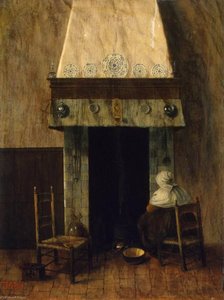
- “An Old Woman by a Fireplace”
- “The Little Nurse”
- “Interior with a Woman Sleeping by the Fireplace”
问答详情
Jacob Vrel 还有哪些别名?
Jacob Vrel 也被称为 Jacobus Frel, Jacobus Vrel, Vreel J., Vrel, J. Vreel。
我可以通过主题来探索 Jacob Vrel 的作品吗?
您可以在Jacob Vrel的主题索引页面上,按主题探索其作品。
可以按媒介类型浏览 Jacob Vrel 的作品吗?
您可以在Jacob Vrel的所有媒介页面上按媒介浏览其作品。