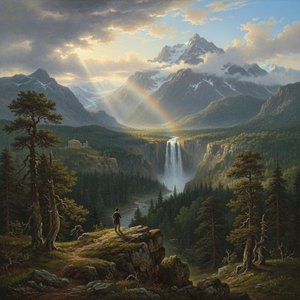
James Hey Davies: A Shepherd of the English Landscape
James Hey Davies (1844-1930) wasn’t a name that dominated the grand halls of Victorian art, yet his canvases quietly captured the enduring beauty and spirit of rural England. Born in Manchester, a city then undergoing rapid industrial transformation, Davies found solace and inspiration not amidst the factories and bustle, but in the rolling hills, verdant pastures, and meandering rivers of his native North West. His life’s work became an intimate portrait of this landscape – a celebration of its light, color, and timeless charm, rendered with a sensitivity that belies his position as a key figure within the Manchester School of Painters.
Davies' early artistic education began modestly, studying drawing at the Manchester School of Art. However, he quickly rejected the prevailing academic style, seeking instead to emulate the Impressionists who were revolutionizing painting in France. This desire for direct observation and capturing fleeting moments led him to embark on a pivotal journey to Pont-Aven in Brittany around 1872. This immersion in the French Impressionist movement proved transformative, shaping his technique and influencing his approach to color and light. He spent considerable time absorbing the techniques of artists like Monet and Pissarro, learning to paint *en plein air* – directly from nature’s source – a practice that would become central to his artistic identity.
The Pastoral Vision: Subject Matter and Technique
Davies' paintings are overwhelmingly devoted to depicting scenes of rural England. He wasn’t interested in grand historical narratives or dramatic events; instead, he focused on the everyday rhythms of life – shepherds tending their flocks, farmers working the land, children playing in meadows, and the quiet beauty of a sunset over a lake. His subjects were often humble, reflecting a deep respect for the rural community and its traditions. His landscapes are characterized by a remarkable attention to detail, meticulously rendered foliage, and an almost photographic accuracy in capturing the textures of grass, stone, and water.
Technically, Davies’ work is rooted in Impressionism but possesses a distinctly British sensibility. He employed loose brushstrokes and vibrant colors – often utilizing a palette dominated by greens, blues, and browns – to convey the atmospheric effects of light and weather. He skillfully captured the interplay of sunlight on water, the dappled shade beneath trees, and the shifting hues of the sky. His compositions are typically balanced and harmonious, creating a sense of tranquility and serenity. He was particularly adept at portraying the changing seasons, capturing the vibrant greens of spring, the golden hues of autumn, and the stark beauty of winter landscapes.
Influence and Recognition
Davies’ association with the Manchester School of Painters – a group of artists who challenged academic conventions and embraced a more naturalistic approach to art – was crucial to his development. He shared a studio space and artistic philosophy with fellow painters like Joshua Anderson Hague, John Houghton Hague, and John Herbert Evelyn Partington, all of whom were committed to painting *en plein air* and capturing the essence of the British countryside. This collective spirit fostered experimentation and innovation, pushing the boundaries of traditional landscape painting.
Davies’ work received considerable recognition during his lifetime. He exhibited regularly at prestigious venues such as the Royal Academy and the Royal Manchester Institution, earning critical acclaim for his skillful depictions of rural England. Notably, he was awarded the Turner Gold Medal in 1875 – a highly coveted prize recognizing excellence in landscape painting – solidifying his reputation as one of Britain’s leading artists. His paintings are now held by major museums including the National Museum Wales, Manchester Art Gallery, and Salford Museum.
Legacy and Enduring Appeal
Though often overlooked by mainstream art history, James Hey Davies' contribution to British landscape painting is significant. His meticulous observation, sensitive portrayal of rural life, and masterful use of light and color continue to resonate with viewers today. His paintings offer a poignant glimpse into a bygone era – a time when England’s countryside was still largely untouched by industrialization and when artists sought inspiration in the beauty of nature. Davies' legacy lies not only in his individual works but also in his role as a key figure within the Manchester School of Painters, shaping the course of British art at the turn of the 20th century.
问答详情
如何按特定主题查找 James Hey Davies 的作品?
您可以通过艺术家关键词分类页面,按关键词探索James Hey Davies的作品。每个关键词都汇集了相关的艺术品。
我可以通过主题来探索 James Hey Davies 的作品吗?
主题索引 页面按主题对 James Hey Davies 的作品进行了分类索引。
我可以通过色调来浏览 James Hey Davies 的作品吗?
您可以在James Hey Davies的按色调浏览页面上,按色调浏览其作品。