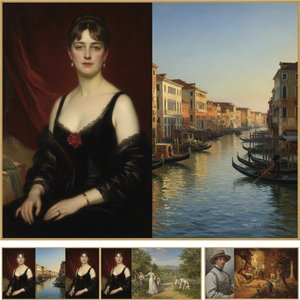
The Luminous Legacy of John Henry Brown
In the delicate, sun-drenched era of the American Victorian period, few artists captured the quiet dignity of a changing nation quite like John Henry Brown. Born in Philadelphia in 1818, Brown emerged from the heart of one of America's most vibrant cultural hubs to become a master of the portrait miniature. His life and work serve as a window into a bygone age, where art was not merely observed on distant walls but held close to the heart, often tucked into a locket or worn as a cherished keepsake. Brown’s specialty lay in the demanding medium of watercolor on ivory, a choice that allowed him to exploit the natural translucency of the substrate to create skin tones that seemed to glow with an inner, lifelike warmth.
The artistry of Brown was defined by a profound marriage of technical precision and emotional resonance. While his training was rooted in the classical traditions of Neoclassical elegance—characterized by meticulous rendering of textures, the soft fold of fine silk, and the precise geometry of facial features—he was not immune to the shifting winds of the nineteenth century. There is a subtle, burgeoning awareness of evolving aesthetic sensibilities in his work, a hint of the light-driven observations that would later define Impressionism. This unique blend allowed him to uphold the formal standards required by his high-society patrons while imbuing his subjects with a psychological depth that transcended mere likeness.
Mastery of the Miniature and the Ivory Canvas
To understand Brown’s contribution to American art, one must appreciate the immense technical difficulty of his chosen craft. Working on such a minuscule scale required an almost superhuman level of focus and a steady hand capable of executing microscopic details. His process involved layering delicate washes of color to build depth, using the ivory base to reflect light back through the pigment. This technique was particularly effective for capturing the subtle nuances of expression that define his most celebrated works. Whether he was depicting the soft features of a young girl or the weathered gravity of a statesman, Brown’s ability to convey character through minute variations in shade was unparalleled.
His repertoire of subjects often included the very architects of American history and the elite of Philadelphia society. Some of his most notable achievements include:
- James Buchanan: A striking watercolor on ivory created in 1865, capturing the 15th President of the United States with a sense of historical weight during the tumultuous aftermath of the Civil War.
- Harriet Lane Johnston: An 1878 portrait that showcases his mastery of composition and his ability to imbue a subject with poise and elegance.
- Mrs. John Willis Ellis (Mary White): A breathtakingly small piece from 1846, measuring only 7 x 5 cm, which demonstrates his skill in creating profound impact within a tiny frame.
- Ada Brown: A tender 1847 miniature that exemplifies his ability to capture the innocence and delicate beauty of youth.
A Lasting Impression on American Portraiture
Though the era of the portrait miniature eventually gave way to larger-scale oil paintings and the advent of photography, the historical significance of John Henry Brown remains undiminished. His work provides an invaluable visual record of the social hierarchy and the aesthetic values of 19th-century America. Through his eyes, we see a world that valued permanence, grace, and the meticulous preservation of identity. Today, much of his legacy is preserved within prestigious institutions such as the Smithsonian American Art Museum, where his portraits continue to offer scholars and art lovers alike a glimpse into the soul of the Victorian age.
Brown’s ability to bridge the gap between the formal requirements of a commission and the intimate reality of a human face ensures his place in the canon of American portraitists. He did not merely paint faces; he captured the essence of an era, leaving behind a luminous trail of ivory and watercolor that continues to shine with the dignity of the past.
问答详情
可以按心情浏览 John Henry Brown 的作品吗?
John Henry Brown 的 情境空间 汇集了该艺术家的多件作品,并按心情分类呈现。
在哪里可以浏览 John Henry Brown 的全部作品?
您可以在 John Henry Brown 的 全部作品 页面上浏览其在 本站 上的所有作品。
如何按特定主题查找 John Henry Brown 的作品?
您可以通过艺术家关键词分类页面,按关键词探索John Henry Brown的作品。每个关键词都汇集了相关的艺术品。