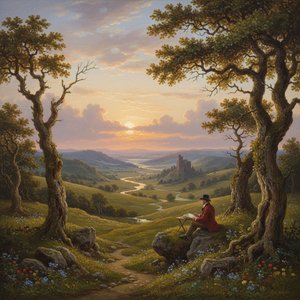
John White: Pioneer of American Watercolor and the Lost Colony’s Witness
Born in London around 1540, John White’s life was a remarkable convergence of exploration, artistry, and historical significance. He wasn't merely an artist; he was a pivotal figure in the earliest attempts to establish English settlements in North America, serving as both chronicler and visual recorder of a nascent society. His legacy rests not only on his exquisite watercolor paintings but also on his role as governor of Roanoke Island during the ill-fated “Lost Colony” – a story that continues to fascinate centuries later.
White’s early life remains shrouded in some mystery, with the exact details of his birth and training difficult to definitively confirm. Records suggest he was christened on February 22, 1539, though this date is subject to debate. What *is* known is that he possessed a keen artistic talent, likely nurtured through apprenticeship within London’s thriving illustration scene during the late sixteenth century. This foundational training would prove crucial as he embarked on his extraordinary journey across the Atlantic.
The Roanoke Expedition and Early Observations
In 1585, John White joined Sir Ralph Lane's expedition to Roanoke Island, a venture intended to establish a permanent English foothold in North America. As artist and mapmaker for the expedition, he meticulously documented the landscape and its indigenous inhabitants – primarily the Algonkin people. These watercolors, now treasured within the British Museum’s print room, represent an unparalleled visual record of Native American life on the Eastern Seaboard during that era. Unlike many contemporary depictions, White's work strives to portray the Algonkin with a degree of respect and accuracy, capturing their clothing, tools, dwellings, and social customs.
His sketches weren’t simply observational; they were imbued with a sense of curiosity and an attempt to understand the culture he encountered. He depicted scenes of daily life – fishing, hunting, farming – alongside portraits of individuals, offering invaluable insights into their beliefs and practices. These images stand as some of the earliest and most detailed visual representations of Native American societies in North America, providing a crucial window into a vanished world.
Governor of Roanoke: A Failed Dream
In 1587, White was appointed governor of the second attempt at establishing a permanent colony on Roanoke Island. This venture, led by Sir Walter Raleigh, aimed to create a self-sustaining settlement but ultimately failed. White’s tenure as governor was fraught with challenges – disease, dwindling supplies, and strained relations with the native Algonkin. Despite these difficulties, he persevered, attempting to maintain order and foster cooperation.
The most poignant aspect of White's governorship is the mystery surrounding the colony’s disappearance in 1590. Upon his return from England for supplies, he found Roanoke deserted, with only a cryptic message carved into a post: “CROATOAN.” This enigmatic clue has fueled countless theories and expeditions over the centuries, cementing the Lost Colony as one of America's most enduring historical puzzles.
Retirement and Legacy
Following the failure of the colony, John White returned to England and spent his remaining years reflecting on the “evils and unfortunate events” that had led to Roanoke’s demise. Despite this disappointment, he never entirely abandoned hope for the survival of his daughter and granddaughter, who were believed to be among those lost at Roanoke.
White's artistic output continued throughout his retirement, producing works like “Panel for Music Room,” a refined example of his watercolor style characterized by delicate detail and subtle color palettes. He also became involved in the arts community in Ireland, contributing to the aesthetic movement of his time. John White’s legacy extends far beyond his beautiful paintings; he remains an essential figure in American history, a witness to the dawn of colonization, and a poignant reminder of the complexities and tragedies inherent in the pursuit of new frontiers.
Artistic Style and Influences
White's watercolor technique is notable for its meticulous observation and delicate rendering. He employed a loose, expressive style, capturing the textures of the landscape and the nuances of human expression with remarkable skill. His work demonstrates an understanding of light and shadow, creating atmospheric depth and a sense of realism. While his training in London likely provided him with foundational skills, it’s believed he was influenced by the burgeoning artistic trends of the time, particularly the works of Flemish masters known for their detailed landscapes.
His depictions of Native Americans are particularly noteworthy for their attempt to represent them accurately and respectfully, a rarity in contemporary European art. He avoided stereotypical portrayals, instead focusing on capturing their daily lives and cultural practices.
问答详情
如何浏览 John White 的全部作品?
您可以在 John White 的 全部作品 页面上浏览其在 本站 上的所有作品。
是否有John White作品的3D虚拟展厅巡览?
您可以在John White的3D 艺术展厅页面中,通过3D展厅欣赏其艺术作品。
John White 出生于哪个国家和城市?
John White 出生于 United Kingdom 的 London。
John White 的作品传达了怎样的情绪?
艺术家的 情境空间 页面按氛围分类展示了 John White 的艺术作品。