The Silent Majesty of the Spanish Baroque
In the quiet, sun-drenched landscapes of 16th-century Spain, a singular vision began to emerge that would forever alter the course of European still life painting. Juan Sánchez Cotán, born in the historic town of Orgaz near Toledo around 1560, was not merely a painter of objects, but a poet of the profound. While his contemporaries often sought the grand drama of sweeping religious narratives or the ornate complexities of Mannerism, Cotán turned his gaze inward, finding the infinite within the infinitesimal. His work serves as a bridge between the fading echoes of the Renaissance and the burgeoning, shadow-drenched intensity of the Baroque era.
The foundations of his artistry were laid in the intellectual and spiritual crucible of Toledo. As a student of Blas de Prado, Cotán inherited a certain Mannerist elegance, yet he possessed an innate drive to strip away artifice. His early years were spent navigating the religious and aristocratic circles of Toledo, where he mastered the art of the altarpiece and the portrait. However, it was his transition toward the bodegón—the Spanish still life—that would secure his immortality. In these works, he achieved a level of realism that felt less like mere imitation and more like a spiritual encounter with the physical world.
The Geometry of Devotion
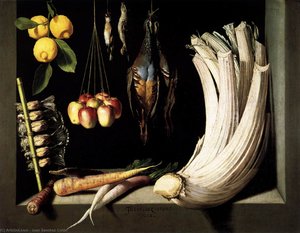
To look upon a Sánchez Cotán masterpiece is to enter a space of monastic stillness. His most celebrated period, roughly between 1602 and 1617, is defined by an almost mathematical precision. He frequently utilized a compositional device known as the shallow niche, where objects are arranged within a dark, recessed space that seems to push forward toward the viewer. Within these architectural confines, a cabbage, a melon, or a quince is suspended in a state of eternal grace. There is no clutter here; there is only the essential.
The technique employed by Cotán was nothing short of revolutionary for his time. He utilized tenebrism—the dramatic contrast between deep, impenetrable shadows and piercing highlights—to sculpt his subjects out of the darkness. This use of light does more than just define form; it imbues humble foodstuffs with a divine presence. A single drop of moisture on a cucumber or the textured skin of a lemon becomes a subject of intense contemplation. Through this meticulous attention to detail, Cotán transformed the mundane into the monumental, suggesting that the divine could be found in the simplest elements of creation.
His compositions are characterized by several defining elements:
- Mathematical Harmony: An arrangement of objects that feels balanced yet organic, often following a strict geometric logic.
- Austere Realism: A rejection of the ostentatious pronkstilleven style found in the Netherlands in favor of a stark, humble beauty.
- Spiritual Depth: The use of light to evoke a sense of mystery and religious meditation.
A Legacy Carved in Shadow
As his life progressed, Cotán’s path took a turn toward even deeper asceticism. In 1612, he moved to Granada, eventually dedicating himself to the Carthusian monastery. This period of intense religious devotion mirrored the austerity of his paintings, as he moved away from the complex still lifes of his Toledo years toward a life of quiet contemplation. Though his output changed, the spiritual essence that defined his earlier work remained a permanent fixture of his soul.
The historical significance of Juan Sánchez Cotán cannot be overstated. He was a pioneer who paved the way for the great masters of the Spanish Golden Age. Without his foundational realism and his mastery of light, the works of Francisco de Zurbarán might never have achieved their characteristic spiritual weight. He taught future generations that the smallest object, when viewed with enough reverence, can contain the entire universe. Today, his paintings remain much more than historical artifacts; they are windows into a world where silence speaks and where every shadow holds a secret.
问答详情
在哪里可以按关键词浏览 Juan Sanchez Cotan 的作品?
Juan Sanchez Cotan 的 关键词分类 页面通过关键词对艺术家的作品进行了分类。
Juan Sanchez Cotan 出生于哪个国家和城市?
Juan Sanchez Cotan 出生于 Spain 的 Orgaz。
是否有Juan Sanchez Cotan作品的3D虚拟展厅巡览?
您可以进行虚拟参观:在 Juan Sanchez Cotan 的 3D 艺术展厅 页面中,您可以在三维画廊里欣赏艺术家的作品。