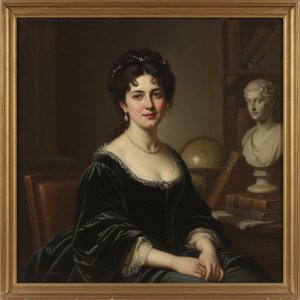
Malcolm Stewart: A Portraitist of Victorian England
Malcolm Stewart (1829–1916) stands as a significant, yet often overlooked, figure in 19th-century British portraiture. Born in Glasgow, Scotland, his artistic journey unfolded against the backdrop of rapid industrialization and shifting social landscapes – experiences that profoundly shaped his distinctive style and subject matter. Stewart’s work offers a poignant glimpse into Victorian society, capturing not just outward appearances but also subtle nuances of character and the quiet dignity of everyday life.
Stewart's early artistic training remains somewhat shrouded in mystery, though he is believed to have studied under various artists in Glasgow before establishing himself as an independent practitioner. His initial works leaned towards genre scenes depicting working-class life – a period often neglected by mainstream art at the time. However, it was his foray into portraiture that truly cemented his reputation and established him as a master of capturing the essence of his subjects. He quickly developed a distinctive technique characterized by soft lighting, delicate brushwork, and an almost melancholic atmosphere.
The Influence of Luminism and Japanese Aesthetics
Stewart’s artistic development was significantly influenced by two key movements: Luminism and Aesthetic Japonisme. Luminism, originating in the United States, emphasized capturing fleeting moments of light and atmosphere, often depicting landscapes with a sense of serenity and introspection. This focus on subtle tonal variations and atmospheric perspective found its way into Stewart's portraiture, lending his works an ethereal quality. Simultaneously, he was deeply fascinated by Japanese art, particularly Ukiyo-e prints – woodblock images that depicted scenes from everyday life, landscapes, and portraits. The influence of Japanese aesthetics is evident in Stewart’s compositions, which often feature asymmetrical arrangements, flattened perspectives, and a deliberate avoidance of dramatic contrasts.
The adoption of Japanese compositional elements—particularly the use of negative space and simplified forms—allowed Stewart to create portraits that felt both intimate and subtly enigmatic. He skillfully blended these influences with his own artistic sensibilities, resulting in a unique style that is simultaneously rooted in Victorian tradition and infused with an exotic sensibility.
Subjects and Themes: Dignity in the Ordinary
Stewart’s subjects were remarkably diverse, ranging from wealthy industrialists and prominent politicians to humble laborers and members of the working class. He eschewed the conventional practice of depicting his sitters in opulent settings or formal poses. Instead, he sought to capture their inherent dignity and humanity within ordinary circumstances. Many of his portraits depict individuals engaged in everyday activities – reading, conversing, tending to domestic duties – revealing a deep empathy for the lives of those around him.
His portraits of working-class men and women are particularly noteworthy for their honesty and realism. Stewart avoided romanticizing poverty or portraying his subjects as victims; instead, he presented them with quiet dignity and respect, highlighting their resilience and inner strength. Notable examples include portraits of Thomas Campbell, a prominent Scottish politician, and Dr. Livingstone, the famed explorer – both figures who embodied the spirit of Victorian ambition and exploration.
Technique and Legacy
Stewart’s technical skill lay in his mastery of tonal gradations and subtle brushwork. He employed a delicate layering technique, building up color slowly to create a sense of depth and atmosphere. His portraits are characterized by soft lighting, diffused shadows, and an almost velvety texture. He was particularly adept at capturing the nuances of facial expression – conveying a range of emotions with remarkable subtlety.
Despite his considerable talent, Stewart’s work received relatively little recognition during his lifetime. However, in recent decades, there has been a growing appreciation for his unique artistic vision and his significant contribution to Victorian portraiture. His paintings are now housed in major museums across the United Kingdom, including the National Gallery of Scotland and the Walker Art Gallery in Liverpool, ensuring that his legacy as one of Britain’s most accomplished portraitists will endure.
Further Exploration
For further information on Malcolm Stewart's life and work, consider visiting these resources:
问答详情
Malcolm Stewart 还有哪些别名?
Malcolm Stewart 也以 Stewart, Malcolm 等其他名称为人所知。
目前目录中共有多少件 Malcolm Stewart 的作品可供浏览?
您可以在 全部作品 页面浏览由 Malcolm Stewart 创作的 13 件作品 件作品。
在哪里可以参观Malcolm Stewart作品的3D虚拟展厅?
Malcolm Stewart 的 3D 艺术展厅 可以在虚拟三维展厅中欣赏到艺术家的作品。