A Pastoral Vision: The Life and Art of Nicolaes Berchem
Nicolaes Berchem, born in Haarlem around 1620, emerged during the Dutch Golden Age as a master of idyllic landscape painting. While precise details surrounding his early life remain somewhat elusive, we know he came from a family with artistic inclinations – his brother Pieter was also a painter. Unlike many artists who apprenticed under established masters for years, Berchem received initial training from his father and then briefly studied with Andreas van Eyschen, though it appears to have been more of an informal arrangement than a traditional apprenticeship. This independent path perhaps contributed to the unique character of his work, which eschewed strict adherence to prevailing styles in favor of a deeply personal vision. Haarlem at this time was a vibrant center for artistic innovation, and Berchem absorbed influences from painters like Esaias van de Velde and Jan van Goyen, particularly their atmospheric rendering of light and expansive skies. However, he quickly developed his own distinctive voice, one that would become synonymous with the idealized pastoral landscape.Italianate Landscapes and a Romantic Imagination
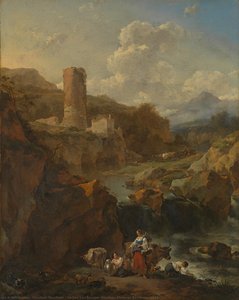
Berchem’s artistic career took an important turn in the mid-1650s when he embarked on a journey to Italy – a pilgrimage undertaken by many Dutch artists seeking inspiration from the classical world and the sun-drenched landscapes of the Mediterranean. Although the exact duration of his stay is debated, it profoundly impacted his style. He didn’t simply copy Italian scenes; instead, he synthesized what he observed with his own Northern European sensibilities. His “Italianate Landscapes” are not literal depictions but rather romanticized visions infused with a sense of tranquility and harmony. These paintings often feature classical ruins, shepherds tending their flocks, and figures engaged in leisurely activities – all bathed in a warm, golden light that evokes the idyllic world of Arcadia. He was particularly drawn to the Roman countryside, which he populated with meticulously rendered animals, becoming renowned for his ability to capture their natural movements and behaviors. This fascination with animal life would remain a hallmark of his oeuvre throughout his career.Technique and Style: A Blend of Observation and Invention
Berchem’s technique was as distinctive as his subject matter. He employed a relatively limited palette, relying on earth tones – browns, ochres, greens, and grays – to create a sense of atmospheric depth and realism. His brushwork was loose and fluid, allowing the texture of the paint to contribute to the overall effect. He masterfully used glazing techniques to build up layers of color and luminosity, creating a subtle interplay of light and shadow. What truly set Berchem apart was his ability to combine meticulous observation with imaginative invention. He would often sketch animals from life – in fields, markets, or menageries – then incorporate them into his landscapes with remarkable accuracy. However, he wasn’t afraid to alter the composition or add elements that enhanced the overall aesthetic appeal. His paintings are not simply records of what he saw but rather carefully constructed compositions designed to evoke a specific mood and feeling. He was a storyteller as much as he was a painter.Legacy and Influence: A Lasting Pastoral Ideal
Throughout his long career, Berchem enjoyed considerable success and recognition. He became a member of the Haarlem Guild of St. Luke in 1653 and taught numerous students, including his own son, Pieter Berchem II. His influence extended beyond his immediate circle, impacting generations of landscape painters who admired his ability to create harmonious compositions and evoke a sense of tranquility.- His work was particularly influential on English landscape artists in the 18th century.
- Painters like Richard Wilson drew inspiration from Berchem’s idealized pastoral scenes, adapting them to the British countryside.
- Berchem's emphasis on atmosphere and light also resonated with later Romantic painters.
问答详情
Nicolaes Berchem 的作品受欢迎程度如何?
Nicolaes Berchem 拥有一个 统计数据 页面,其中展示了该艺术家在 本站 上的作品统计数据。
在哪里可以按颜色分类查看Nicolaes Berchem的艺术作品?
您可以在Nicolaes Berchem的色彩索引页面上按色彩探索其作品。
Nicolaes Berchem 最常使用的色彩有哪些?
Nicolaes Berchem 的 色彩基因 展示了该艺术家作品的色彩特征。