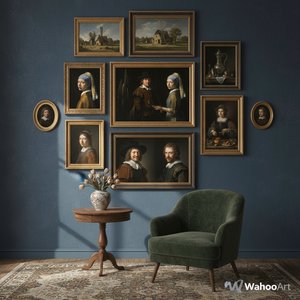
The Haunting Realism of Isaac van Ostade
Isaac van Ostade (1621-1649) remains a profoundly enigmatic figure in the history of Dutch Golden Age painting, a master whose tragically short career produced works of startling immediacy and emotional depth. Often overshadowed by his more celebrated brother, Adriaen, Isaac carved out a unique artistic identity—one defined by a gritty realism that unflinchingly depicted the lives of ordinary people, particularly those struggling within the harsh realities of rural existence. His paintings aren’t merely scenes; they are windows into a world of quiet desperation, weathered resilience, and the subtle beauty found in the commonplace.
Born in Haarlem, Isaac's artistic journey began under the tutelage of his elder brother, Adriaen. Initially, he closely followed Adriaen’s style, producing interiors bathed in muted browns and grays—scenes of peasant life, tavern gatherings, and domestic routines. However, around 1641, a shift occurred. Influenced by the works of Rembrandt and the landscape painters Esaias van de Velde and Salomon van Ruysdael, Isaac began to develop his own distinctive voice. He moved away from the purely interior scenes, embracing the world outside—frozen canals, muddy roadsides, and humble farmsteads. This transition marked a pivotal moment in his artistic development, laying the foundation for his most enduring legacy.
The Palette of Poverty: Subject Matter and Technique
Isaac van Ostade’s subjects were deliberately chosen to reflect the realities of 17th-century Dutch society—a society grappling with poverty, hardship, and the relentless demands of agricultural life. He frequently depicted scenes of travelers resting at inns, weary peasants returning from their labors, and families huddled around meager fires. His compositions are characterized by a remarkable attention to detail, capturing not just the outward appearance of his subjects but also their emotional states—a sense of quiet resignation, stoic endurance, or fleeting moments of joy.
Technically, van Ostade’s work is distinguished by its masterful use of light and shadow. He employed a technique known as “chiaroscuro,” creating dramatic contrasts between brightly lit areas and deep shadows—a device that heightened the emotional impact of his scenes and imbued them with a palpable sense of atmosphere. His brushwork was often loose and expressive, conveying a feeling of immediacy and spontaneity. He wasn’t interested in idealized beauty; instead, he sought to capture the authentic textures and imperfections of everyday life – the worn fabrics, the rough-hewn furniture, the weathered faces of his subjects.
Winter Landscapes and the Echoes of Rembrandt
Perhaps the most iconic aspect of van Ostade’s oeuvre is his series of winter landscapes. These paintings—often featuring skaters on frozen canals or sledders navigating snow-covered roads—are imbued with a haunting beauty and a sense of melancholy. These scenes, rendered in muted tones of gray and blue, evoke the starkness and isolation of the Dutch winter landscape. The influence of Rembrandt is readily apparent in van Ostade’s use of light and shadow to create dramatic effects and convey emotional depth. However, unlike Rembrandt's grand narratives, van Ostade focused on capturing a fleeting moment—a single figure pausing for rest, a pair of skaters gliding across the ice.
A Legacy of Unfinished Potential
Isaac van Ostade’s life was tragically cut short at the age of twenty-eight. He died in Haarlem in 1649, leaving behind a relatively small body of work—approximately four hundred paintings. Despite his brief career, van Ostade exerted a significant influence on subsequent generations of Dutch artists. His unflinching realism and emotional honesty paved the way for later painters who sought to depict the lives of ordinary people with greater sensitivity and insight.
Today, Isaac van Ostade’s paintings are treasured for their ability to transport us back in time—to a world of hardship, resilience, and quiet beauty. His work serves as a poignant reminder of the enduring power of art to capture the essence of human experience, even in its most challenging forms.
问答详情
Ostade Isaack Van 的作品受欢迎程度如何?
Ostade Isaack Van 拥有一个 统计数据 页面,其中展示了该艺术家在 本站 上的作品统计数据。
在哪里可以按艺术流派浏览 Ostade Isaack Van 的作品?
您可以在Ostade Isaack Van的全部流派页面上,按艺术流派浏览其作品。
Ostade Isaack Van 的创作时期属于哪个历史阶段?
Ostade Isaack Van 的创作活跃于 Early Modern 时期,这一时期确立了艺术家在艺术史上的地位。