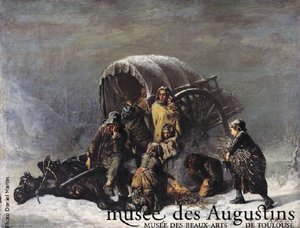
The Compassionate Eye of Pierre Alexandre Antigna
In the heart of nineteenth-century France, a period defined by profound social upheaval and shifting artistic paradigms, Jean Pierre Alexandre Antigna emerged as a painter of unparalleled empathy. Born in Orléans in 1817, his early artistic journey was rooted in the traditional landscapes of his youth, shaped under the watchful eye of the local painter François Salmon. However, the pull of Paris proved irresistible. Upon entering the prestigious École Nationale Supérieure des Beaux-Arts in 1837, Antigna found himself immersed in a world of academic rigor, studying under masters such as Sébastien Norblin de la Gourdaine and the renowned Paul Delaroche. These early years were marked by a focus on religious subjects and formal portraiture, adhering to the established stylistic conventions of the era.
Yet, the true metamorphosis of Antigna’s soul occurred not within the gilded halls of the academy, but in the shadowed, narrow streets of the Île Saint-Louis. Living amidst the impoverished quarters of Paris, the artist became a witness to the raw, unvarnated struggles of the urban poor. This profound exposure to human hardship acted as a catalyst, steering him away from idealized religious iconography toward a gritty, unflinching Realism. By the time the Revolution of 1848 swept through France, Antigna had fully embraced a style that sought to document the weight of existence. His canvases began to pulse with the heavy burdens and quiet resilience of those on the margins of society, rendered with a textured brushwork and an emotional depth that commanded the attention of the Parisian Salon.
A Journey Through Light and Naturalism
As his career progressed, Antigna’s artistic vision expanded beyond the urban confines of Paris. Driven by an insatiable curiosity about the human condition and the natural world, he embarked on extensive travels through the rugged landscapes of Brittany and the vibrant terrains of Spain. These journeys allowed him to blend his social consciousness with a burgeoning Naturalism. Around 1860, his work began to reflect a meticulous observation of nature, where the atmospheric qualities of the landscape became as much a subject as the people inhabiting them. Whether capturing the dramatic tension of a storm or the quiet dignity of a rural worker, his technique remained anchored in a sense of profound compassion.
His mastery was formally recognized by the French state when he was awarded the Legion of Honor in 1861, a milestone that solidified his standing among the significant figures of his generation. Even as his style evolved toward more naturalist depictions, the core of his work remained an exploration of vulnerability and strength. Notable works such as The Lightning demonstrate this duality, where a family huddled during an electrical storm serves as a poignant meditation on familial love amidst the terrifying power of nature. Through his use of light, shadow, and impasto textures, Antigna did more than merely paint scenes; he captured the very essence of survival.
Legacy of a Social Realist
The historical significance of Pierre Alexandre Antigna lies in his ability to bridge the gap between Romantic emotion and Realist truth. He did not merely observe poverty; he imbued it with a dignity that challenged the era's social hierarchies. His life, which concluded in Paris in 1878, left behind an oeuvre that serves as a vital visual record of nineteenth-century French life. His influence can be seen in the way he utilized the following elements to elevate his subjects:
- Emotional Resonance: The ability to transform a scene of hardship into a universal study of human resilience.
- Textural Depth: Using heavy, expressive brushstrokes to mirror the ruggedness of the lives he depicted.
- Atmospheric Storytelling: Leveraging natural light and weather—such as in his depictions of storms—to reflect internal psychological states.
- Social Witness: A commitment to documenting the marginalized, ensuring their presence was felt within the prestigious halls of the art world.
Today, Antigna is remembered not just as a painter of scenes, but as a compassionate voice of his era, an artist who looked into the darkness of urban struggle and found the enduring light of the human spirit.
问答详情
可以按媒介类型浏览 Pierre Alexandre Antigna 的作品吗?
若要查找Pierre Alexandre Antigna在特定媒介下的所有作品,请访问艺术家的所有媒介页面。
在哪里可以按色调浏览 Pierre Alexandre Antigna 的作品?
按色调浏览 页面按色调将 Pierre Alexandre Antigna 的艺术作品进行了分类。
在哪里可以按关键词浏览 Pierre Alexandre Antigna 的作品?
您可以通过艺术家关键词分类页面,按关键词探索Pierre Alexandre Antigna的作品。每个关键词都汇集了相关的艺术品。