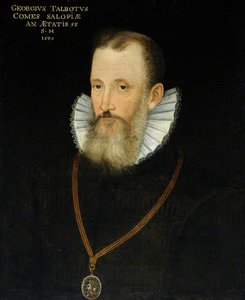
The Quiet Master of Tudor Portraiture
In the grand, gilded tapestry of the English Renaissance, certain names shine with an unshakeable brilliance, while others linger in the soft shadows of history, possessing a subtle, enduring grace. Rowland Lockey (c. 1565–1616) belongs to that second, more mysterious category. A figure often discussed in the periphery of much larger luminaries, Lockey was an artist whose hands bridged the gap between the meticulous precision of the early Tudor era and the burgeoning dynamism of the Jacobean age. Born likely in London, the son of a skilled crossbow maker, Lockey’s journey from the workshops of Fleet Street to the prestigious circles of the royal court is a testament to the vibrant, interconnected nature of Elizabethan craftsmanship.
His artistic identity was forged in the crucible of an apprenticeship that placed him at the very heart of English aesthetic evolution. Beginning in 1581, Lockey studied under Nicholas Hilliard, the legendary miniaturist to Queen Elizabeth I. This formative period was far more than a mere technical education; it was an immersion into a world where every glint of gold and every delicate line of vellum held profound political and social meaning. Under Hilliard’s tutelage, Lockey mastered the art of the subtle—learning how to manipulate light and layer glazes to create a sense of depth and vitality that could breathe life into a flat surface. This training as both a painter and a goldsmith endowed his work with a unique tactile quality, blending the precision of metalwork with the fluid elegance of oil painting.
A Legacy of Reinterpretation and Devotion
While Lockey is frequently categorized as a copyist, such a label fails to capture the soulful nuance he brought to his subjects. His most celebrated achievements lie in his monumental reproductions of Hans Holbein the Younger’s iconic works, most notably the "Family of Sir Thomas More." In these large-scale canvases, Lockey did not merely replicate; he reinterpreted. Where Holbein’s original captured a frozen, solemn dignity, Lockey’s versions introduced a subtle shift in expression and pose, infusing the figures with a newfound energy that resonated with the changing spirit of the late Tudor period. His ability to inhabit the style of his predecessors while injecting a contemporary vitality is what marks him as a true master of his craft.
Beyond these grand family portraits, Lockey’s oeuvre includes deeply moving individual studies that capture the spiritual and political weight of his era. His depiction of Lady Margaret Beaufort at Prayer stands as a pinnacle of his ability to convey profound intimacy. In this work, he strips away the clamor of courtly life to present a moment of solitary, sacred devotion. Through the masterful use of texture—the heavy folds of black robes contrasted against the crispness of white linen—he creates a space where the viewer feels the very weight of history and piety. This capacity to balance the opulence of noble status with the vulnerability of human emotion is the hallmark of his enduring significance.
The Intersection of Craft and Courtly Life
Lockey’s professional life was deeply intertwined with the prestigious guilds of London, having achieved the status of a freeman of the Worshipful Company of Goldsmiths by 1600. This dual identity as an artist and a goldsmith allowed him to serve the fashionable long galleries of great English houses, providing the essential visual lineage that noble families required to assert their legitimacy and heritage. His work functioned as a vital component of the Tudor social fabric, creating sets of oil paintings that documented the continuity of power and bloodlines.
Ultimately, the historical importance of Rowland Lockey lies in his role as a custodian of the English portrait tradition. He stood at the crossroads of eras, preserving the meticulous techniques of the 16th century while preparing the way for the more expressive styles of the 17th. Though he may remain eclipsed by the giants of the Renaissance, his contributions—characterized by a quiet, meticulous brilliance—continue to offer historians and art lovers a window into the soul of the Tudor and Jacobean worlds.
问答详情
在哪里可以找到关于Rowland Lockey作品的相关统计数据?
Rowland Lockey 拥有一个 访问统计 页面,其中展示了该艺术家在 本网站 上的作品统计数据。
Rowland Lockey 的艺术风格是如何随时间演变的?
您可以在艺术家的 艺术编年史 页面上查阅 Rowland Lockey 作品的编年史,其作品按创作顺序分章节依次呈现。
如何按特定媒介查找 Rowland Lockey 的所有作品?
全部媒介 页面按技法对 Rowland Lockey 的作品进行了分类。