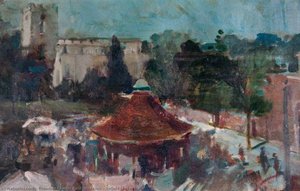
The Urban Chronicles of Theodore Charles Basil Hitchcock
Theodore Charles Basil Hitchcock occupies a unique space in the landscape of 20th and 21st-century art, a chronicler of both the bustling energy of city life and the dramatic narratives of World War II aviation. Born in England, his artistic journey is one defined by meticulous detail, an unwavering eye for atmosphere, and a profound connection to the historical moments he depicts. While biographical details remain somewhat elusive – Hitchcock prefers to let his work speak for itself – it’s clear that his life experiences deeply informed his distinctive style. He emerged as a significant artist during a period of rapid change, witnessing firsthand the anxieties and triumphs of a world at war and the subsequent rebuilding efforts. This context is crucial to understanding the emotional weight embedded within his canvases. Hitchcock isn't simply *recording* scenes; he’s conveying a sense of place, time, and often, an underlying narrative tension.From Cityscapes to Skies: A Developing Vision
Hitchcock’s early work focused predominantly on urban environments – bustling streets, imposing architecture, and the everyday lives unfolding within them. These paintings are characterized by a remarkable precision; each building is rendered with architectural accuracy, every vehicle meticulously detailed, and figures populated the scenes with a sense of purposeful movement. He wasn't interested in romanticizing city life but rather in capturing its raw energy, its complexity, and its often-overlooked beauty. This early period demonstrates a clear influence from realist traditions, yet Hitchcock’s work transcends mere imitation. There is a subtle atmospheric quality present even in these earlier pieces – a play of light and shadow that imbues the scenes with a sense of mood and drama. As World War II intensified, Hitchcock's focus shifted towards aviation art. This wasn’t a sudden departure but rather a natural extension of his existing skills and interests. The skies above England became a new canvas for his meticulous detail, documenting the aircraft, airfields, and pilots that defined the conflict. He quickly gained recognition for his ability to portray these scenes with both technical accuracy and emotional resonance.Technique and Style: A Master of Realism
Hitchcock’s artistic technique is rooted in a deep understanding of realism, but it's a realism tempered by a keen sense of atmosphere and narrative. He typically works with oil paints, employing a layering technique that allows him to build up depth and texture. His brushwork is precise and controlled, yet never feels stiff or mechanical. Instead, there’s a fluidity and dynamism in his application of paint that brings the scenes to life. Color plays a crucial role in his work; he often uses muted tones to create a sense of realism, but strategically employs brighter colors to draw attention to key elements within the composition. His compositions are carefully balanced, guiding the viewer’s eye through the scene and emphasizing the narrative focal points. Whether depicting a bustling city street or a dramatic aerial battle, Hitchcock's work is characterized by a remarkable clarity of detail and an unwavering commitment to accuracy. He meticulously researches his subjects, ensuring that every element – from the architecture of a building to the markings on an aircraft – is historically correct.Major Achievements and Historical Significance
While Hitchcock’s work has been exhibited in numerous galleries and private collections, his significance lies not necessarily in grand exhibitions but rather in the enduring power of his individual paintings. His urban scenes offer a valuable glimpse into the social and architectural landscape of mid-century England, providing a visual record of a rapidly changing world. However, it is his WWII aviation art that has arguably had the greatest impact. He captured the heroism, sacrifice, and technological advancements of the conflict with unparalleled detail and emotional depth. His paintings are not simply depictions of aircraft; they’re portraits of the pilots who flew them, the ground crews who maintained them, and the communities that supported them.- His work provides a valuable historical record of WWII aviation.
- He is celebrated for his meticulous detail and accuracy.
- Hitchcock’s paintings evoke a strong sense of atmosphere and emotion.
问答详情
是否有Theodore Charles Basil Hitchcock作品的3D虚拟展厅巡览?
Theodore Charles Basil Hitchcock 的 3D 艺术展厅 可以在虚拟三维展厅中欣赏到艺术家的作品。
Theodore Charles Basil Hitchcock 的艺术风格是如何随时间演变的?
Theodore Charles Basil Hitchcock 的艺术生涯在 艺术历程 页面上按时期逐一展开:以横向时间轴的形式呈现作品,并按创作时期划分为不同的篇章。
Theodore Charles Basil Hitchcock 最常使用的色彩有哪些?
Theodore Charles Basil Hitchcock 的 色彩基因 展示了该艺术家作品的色彩特征。