Tibor Duray: A Painter of Shadows and Souls
Tibor Duray (1912-1988) remains a compelling figure in Hungarian art, often characterized as an Expressionist painter whose work grappled with themes of social injustice, human suffering, and the weight of history. Born in Budapest, Hungary, into a family steeped in artistic tradition – his father was a renowned sculptor – Duray’s early life provided a foundation for his later explorations of form and emotion. His career unfolded against the backdrop of tumultuous 20th-century Europe, marked by war, political upheaval, and profound social change, experiences that deeply informed his artistic vision.
Duray's formal training began at the Academy of Fine Arts in Budapest, where he honed his technical skills. However, he quickly sought a more independent path, influenced by movements like German Expressionism and the socio-political realities of interwar Europe. He spent time studying in Rome and Paris, absorbing diverse artistic currents while simultaneously developing a distinctly personal style. This period saw him move away from purely academic approaches, embracing bolder colors, dynamic compositions, and a willingness to confront difficult subjects. His early works often depicted the plight of laborers and marginalized communities – a testament to his social conscience and empathy.
A pivotal moment in Duray’s artistic development occurred during World War II. The horrors he witnessed profoundly impacted his work, leading him to create a series of powerfully evocative paintings that captured the devastation and despair of conflict. These works, such as “The Foundered Horse” and “The Helpless,” are not simply depictions of war; they are visceral expressions of human suffering and loss. He utilized stark contrasts in light and shadow, distorted figures, and symbolic imagery to convey a sense of unease and moral questioning. Following the war, Duray continued to explore themes of displacement and resilience, often focusing on the experiences of refugees and displaced persons.
The Landscape as Mirror
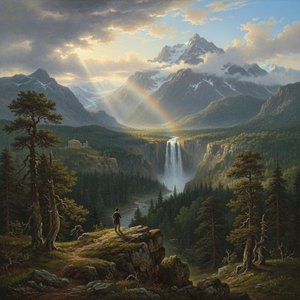
While Duray is best known for his portraits and social commentary, his landscapes are equally significant, offering a crucial counterpoint to his more emotionally charged subjects. He possessed a remarkable ability to capture the essence of Hungarian scenery – from the rolling hills of the countryside to the serene shores of Lake Balaton – transforming these familiar vistas into expressions of mood and emotion. His approach was distinctly Impressionistic, characterized by loose brushwork, vibrant colors, and an emphasis on capturing fleeting moments of light and atmosphere. “Lake Balaton,” for example, is not merely a representation of a beautiful lake; it’s a meditation on tranquility, solitude, and the connection between humanity and nature.
Duray's landscapes frequently served as backdrops to his portraits or social scenes, subtly enriching their emotional impact. He used the natural world to amplify the narratives he was telling – suggesting both hope and despair, beauty and vulnerability. His depictions of rural life, in particular, are imbued with a sense of nostalgia for a disappearing way of life.
Key Works and Artistic Style
Several works stand out as particularly representative of Duray’s artistic vision. “Hunyadi Square,” painted during his time in Paris, exemplifies his ability to blend urban realism with expressive brushwork and a subtle sense of melancholy. The painting captures the bustling energy of Budapest's main square while simultaneously hinting at the underlying tensions and uncertainties of the era. “Sisters” is another notable example, showcasing his skill in portraying human relationships with sensitivity and nuance. His portraits are often characterized by their psychological depth, capturing not just physical likeness but also the inner lives of his subjects.
Duray’s artistic style evolved considerably throughout his career. Initially influenced by German Expressionism, he gradually developed a more personal voice, incorporating elements of Impressionism and Symbolism. His use of color was particularly distinctive – often employing bold, contrasting hues to create dramatic effects. He was also a master of composition, skillfully arranging figures and objects within the frame to achieve maximum visual impact.
Legacy and Recognition
Despite facing periods of relative obscurity during his lifetime, Tibor Duray’s work has gained increasing recognition in recent decades. He received Hungary's prestigious Munkácsy Prize in 1969, a testament to his enduring contribution to the country’s artistic heritage. His paintings are now held in prominent collections throughout Hungary and internationally, including the Hungarian National Gallery. Duray’s legacy lies not only in his individual achievements but also in his willingness to confront difficult subjects with honesty and compassion – qualities that continue to resonate with audiences today.
His work serves as a poignant reminder of the human condition—a reflection on suffering, resilience, and the enduring power of art to bear witness to our shared history.
问答详情
可以按颜色对Tibor Duray的作品进行排序吗?
Tibor Duray 的 色彩索引 页面按色彩对艺术家的作品进行了分类整理。
目前目录中共有多少件 Tibor Duray 的作品可供浏览?
您可以在 全部作品 页面浏览由 Tibor Duray 创作的 31 件作品 件作品。
在哪里可以按色调浏览 Tibor Duray 的作品?
按色调浏览 页面按色调将 Tibor Duray 的艺术作品进行了分类。