A Legacy of Light and Landscape: The Life of William Meadows
The story of William George Meadows is one written in the soft hues of the English countryside and the shimmering reflections of Venetian canals. Born in July 1833 in Bolton, Lancashire, Meadows entered a world already steeped in the salt and spray of maritime tradition. As the son of the celebrated marine painter James Meadows, his earliest visual vocabulary was shaped by his father’s dramatic seascapes and the rhythmic motion of the Atlantic. This foundational connection to the sea provided him with a profound understanding of atmosphere and movement, yet William would eventually steer his brush away from the turbulent waves of his father's legacy toward a more tranquil, contemplative realm of landscape and veduta.
His journey was marked by a certain nomadic grace, reflecting a life that bridged continents. Following his family to the United States in 1842, he spent formative years in Burlington Flats, New York, an experience that expanded his horizons far beyond the borders of Britain. This period of transition allowed him to absorb the burgeoning influences of the Aesthetic Movement. Immersed in the ideals of Ruskinian beauty and the stylistic innovations of figures like Dante Gabriel Rossebtti and John Everett Millais, Meadows began to move beyond mere topographical accuracy. He sought instead to capture the emotional resonance of a scene, transforming landscapes into meditative explorations of nature’s sublime grandeur.
The Venetian Vision and Artistic Evolution
The zenith of Meadows' career arrived through his profound fascination with Venice, a city that served as both his subject and his muse. While many of his contemporaries sought to capture the fleeting, fractured light of pure Impressionism, Meadows approached the Venetian landscape with a deliberate, classical reverence. He looked backward to the masters, studying the structural harmony and color mastery found in the frescoes of Raphael and Michelangelo to inform his compositions. His work became a sophisticated dialogue between the realism of architectural detail and the ethereal quality of light.
As his technique matured, one can observe a beautiful tension within his canvases:
- The Mastery of Atmosphere: His ability to depict the golden afternoon sunlight bathing the Piazza San Marco, creating a sense of warmth and timelessness.
- Compositional Depth: A meticulous use of perspective that allowed viewers to wander through bustling urban waterways, such as in his evocative depictions of The Grand Canal.
- Stylistic Transition: An evolution from the precise, academic detail of his early training toward a looser, more impressionistic brushstroke that prioritized mood over rigid form.
In works like The Scuola Di San Marco From The Grand Canal, Meadows achieves a rare balance, blending the structural weight of the city's architecture with a soft, atmospheric charm that feels almost dreamlike. His paintings do not merely document a location; they evoke a feeling of nostalgia for the Belle Époque, capturing a world of quiet elegance and enduring beauty.
Historical Significance and Enduring Charm
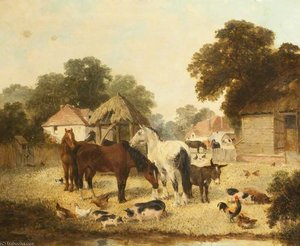
Though historical records regarding his later years remain somewhat enigmatic, the impact of Meadows' oeuvre is undeniable. He carved out a unique niche in the 19th-century British art tradition, standing as a bridge between the Romanticism of J.M.W. Turner and the atmospheric sensibilities of late-century landscape painting. His ability to oscillate between the pastoral serenity of the English countryside—seen in works such as Cattle By A Pond And Another—and the vibrant, sun-drenched streets of Italy, demonstrates a versatile mastery of light and subject.
Today, the work of William Meadows continues to captivate collectors and art historians alike. His paintings serve as windows into a vanished era, offering a sense of peace and a celebration of the classical world. Through his dedication to capturing the soul of a landscape, Meadows ensured that his name would remain synonymous with the tranquil beauty of the natural and architectural worlds, leaving behind a legacy that remains as luminous as a Venetian sunset.
问答详情
William Meadows 还有哪些别名?
William Meadows 也以 William George Meadows 等其他名称为人所知。
在哪里可以按氛围浏览 William Meadows 的作品?
William Meadows 的 情境空间 汇集了该艺术家的多件作品,并按心情分类呈现。
在哪里可以浏览 William Meadows 的全部作品?
您可以在 William Meadows 的 全部作品 页面上浏览其在 本站 上的所有作品。