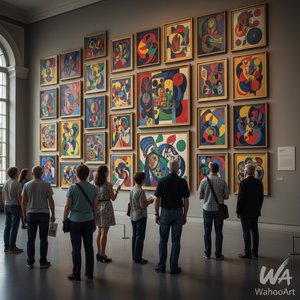
1946. Acrylic On Canvas. Modern Art Museum of Fort Worth.

§ 1Katalogdata


Dette kunstværk er ophavsretsbeskyttet
Kunstværket vist på denne side er beskyttet af ophavsretsloven, hvilket betyder, at vi ikke lovligt kan skabe eller sælge en identisk reproduktion. Denne beskyttelse håndhæves i henhold til internationale aftaler som f.eks. den Bernerkonventionen og af nationale love, herunder de bestemmelser, der er fastlagt i Amerikansk ophavsretslov - Titel 17.
Som et respektfuldt og lovligt alternativ tilbyder vi skræddersyede, håndmalede kunstværker inspireret af originalen. Vores dygtige og professionelle kunstnere studerer omhyggeligt originalens stil, stemning og kunstneriske essens for at skabe et nyt, unikt værk, der fremkalder den samme følelse – samtidig med at det forbliver en original skabelse i egen ret.
Denne metode overholder fuldt ud ophavsretsreglerne, da den ikke indebærer kopiering eller duplikering af det beskyttede kunstværk. I stedet er der tale om en kreativ nytolkning – et nyt maleri, som er inspireret af det oprindelige, men ikke identisk med det.
 Læs mere
§ 2Abstrakt
Beskrivelse af samlerobjektet
Experience Ad Reinhardt's iconic 'Number 6,' a dense abstract composition of layered colors and geometric shapes. Explore its minimalist aesthetic & philosophical depth – a key work by the influential artist.
Kunstnerbiografi
"meta_description": "Ad Reinhardt (1913-1967) var en amerikansk kunstner kendt for sine minimalistiske 'sorte malerier' og sin revolutionerende tankegang om kunstens autonomi – 'kunst for kunstens skyld'. En pioner indenfor abstrakt ekspressionisme og konceptuel kunst."
§ 3Kommentarer
The Genesis of a Void: Ad Reinhardt's 'Number 6'
Adolph Friedrich Reinhardt, born in Buffalo, New York in 1913, wasn’t merely an artist; he was a philosopher of painting. His oeuvre, particularly his iconic “black” paintings from the mid-1960s, represents a radical departure from representational art and a profound exploration of what constitutes ‘art’ itself. 'Number 6,' created in 1946, stands as a pivotal example of this philosophy, embodying Reinhardt's core belief that painting could transcend subject matter and become an end unto itself – a pure, distilled experience. The work isn’t about depicting anything; it’s about the act of painting, the materiality of pigment, and the viewer’s engagement with the canvas as a field of color and texture.
The genesis of 'Number 6' lies within Reinhardt’s broader project to dismantle traditional notions of artistic value. He famously declared he was “painting the last paintings anyone can paint,” a provocative statement that challenged the prevailing emphasis on narrative, technique, and individual expression. This declaration stemmed from his conviction that art should be divorced from any external purpose or meaning, existing solely as an aesthetic experience. 'Number 6' perfectly encapsulates this stance – a seemingly simple composition of overlapping geometric shapes rendered in muted, earthy tones—yet it carries within it the weight of Reinhardt’s theoretical framework.
Composition and Color: A Calculated Chaos
The composition of ‘Number 6’ is deliberately unsettling. It eschews any sense of perspective or hierarchy, presenting a dense field of overlapping rectangles and lines that appear to press in on the viewer. There's no focal point, no immediately discernible subject; instead, the eye wanders across the surface, encountering a continuous interplay of color and form. The palette—a restrained blend of yellows, purples, greens, blacks, and browns—is deliberately muted, avoiding any dramatic contrasts or vibrant hues. This subdued approach reinforces the painting’s emphasis on pure sensation and the materiality of paint.
Reinhardt's technique involved applying thin layers of oil paint in a process he termed “layering.” He built up the image gradually, allowing each layer to dry before adding the next, creating subtle variations in color and texture. This meticulous layering contributes to the painting’s depth and complexity, suggesting a vastness contained within its seemingly simple form. The surface isn't heavily impastoed—it remains relatively smooth, inviting close inspection and encouraging the viewer to contemplate the individual marks of the brush.
Decoding the Void: Symbolism and Interpretation
As an abstract work, ‘Number 6’ resists straightforward interpretation. It doesn’t offer a narrative or representational image; instead, it invites contemplation on themes of complexity, ambiguity, and the limitations of representation. The dense layering can be seen as a metaphor for layers of experience, memory, or thought—a visual embodiment of the multifaceted nature of consciousness. Some scholars interpret the painting as an exploration of the ‘void’ – not as an absence of meaning, but as a space where pure sensation and aesthetic experience reside.
Furthermore, Reinhardt's deliberate use of monochrome shades within the composition can be understood as a rejection of traditional color theory. He sought to strip away any illusionistic effect, focusing instead on the inherent qualities of pigment itself. The painting becomes an exercise in perception—a challenge to the viewer’s assumptions about color and form. It is a testament to Reinhardt's belief that art could exist independently of external reference, offering a direct and immediate experience for the observer.
A Legacy of Minimalism: Reproductions and Beyond
‘Number 6’ remains one of Ad Reinhardt’s most enduring works, admired for its stark simplicity and profound philosophical implications. Hand-painted reproductions capture the subtle nuances of color and texture that are difficult to replicate digitally, offering a faithful representation of Reinhardt's original vision. Whether displayed in a contemporary art gallery or incorporated into a carefully curated interior space, ‘Number 6’ continues to provoke thought and inspire contemplation—a timeless reminder of the power of abstract art to transcend conventional boundaries.
Spørgsmål og svar
Findes der værker, der ligner "Number 6"?
Se lignende værker til "Number 6" på siden Lignende værker.
Hvilken teknik og stil er "Number 6" udført i?
"Number 6" af Ad Reinhardt kombinerer Acrylic On Canvas-teknikken med Abstract Expressionism-stilen. Teknik og stilart beskriver værkets fremstilling og æstetiske udtryk.
Er "Number 6" af Ad Reinhardt et maleri, en tegning eller et tryk?
"Number 6" af Ad Reinhardt er klassificeret som WallArt. Kategorien beskriver den type kunstværk, som originalen er.


 Skift til printsalg


 For kunstværker eller reproduktioner, der er større end 105 cm (ca. 41 tommer) på en hvilken som helst side, vil rammen blive leveret som et adskilt sæt. Denne metode sikrer sikker levering og forhindrer skader under transport.