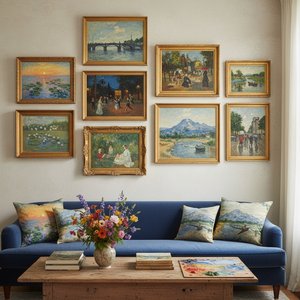
1918. Akryl på lærred. Kunsthaus Zürich.

§ 1Catalogue data


§ 2Abstract
Beskrivelse af samlerobjektet
Udforsk Claudes Monets rolige mesterværk 'Den Japanske Bro', der fanger Giverneys have's fredfyldte skønhed med impressionistiske penselstrøg og livlige farver.
 Vis mere
Kunstnerbiografi
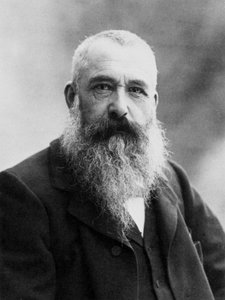
Udforsk Claude Monets verden, impressionismens mester, der er berømt for at indfange flygtigt lys og farve gennem ikoniske landskaber som Vandliljer & Høstakke.
§ 3Commentary
Claude Monet: The Japanese Bridge – A Symphony of Light and Reflection
The Japanese Bridge, painted in 1924 by Claude Monet, stands as a poignant emblem of Impressionism’s enduring fascination with capturing fleeting moments of beauty—specifically, the interplay between light and water. Located within Monet's meticulously crafted Giverny garden, this artwork transcends mere depiction; it embodies an artist’s profound communion with nature and his unwavering pursuit of artistic innovation. More than just a visual representation, “The Japanese Bridge” speaks to a deeper understanding of Impressionist philosophy and its lasting influence on modern art. ### Artistic Context: Impressionism's Pursuit of Perception Claude Monet’s contribution to the Impressionist movement was revolutionary in its rejection of academic conventions favoring meticulous detail and idealized forms. Instead, Monet championed *plein air* painting—working outdoors directly from observation—a practice that prioritized capturing the sensory experience of a scene rather than striving for photographic accuracy. Influenced heavily by Eugène Boudin, Monet recognized that true artistic expression resided not in reproducing reality but in conveying its essence – the ephemeral qualities of light and color as they transformed throughout the day. This ethos permeated his entire oeuvre, shaping his approach to landscapes, seascapes, and portraits alike. ### Composition and Elements: Harmony Amidst Movement Monet’s composition for “The Japanese Bridge” is deceptively simple yet remarkably effective. He presents a tranquil river vista dominated by towering trees—a familiar motif in Monet's Giverny garden—creating an immediate sense of depth and perspective. Two figures, positioned subtly along the bridge’s edge, introduce a human element into this serene landscape, grounding the viewer’s gaze amidst the expansive expanse of foliage and water. The bridge itself serves as a central focal point, mirroring the flowing water beneath and symbolizing a connection between the natural world and human presence—a recurring theme in Monet's artistic explorations. ### Artistic Techniques: Broken Brushstrokes and Color Modulation Monet’s masterful technique is characterized by *broken brushstrokes*, a hallmark of Impressionism that distinguishes it from traditional painting styles. Rather than blending colors smoothly, Monet applied small, irregular strokes of pigment – often juxtaposed with complementary hues – to create shimmering surfaces that capture the dynamism of light and color. This method mimics the way sunlight scatters across water droplets and foliage, generating an illusion of movement and vibrancy. Furthermore, Monet skillfully modulated his palette—shifting between shades of green, brown, and blue—to convey subtle variations in atmospheric conditions and to heighten the emotional impact of the scene. ### Historical Significance: A Legacy of Innovation “The Japanese Bridge” represents a pivotal moment in Monet’s artistic journey – a culmination of his lifelong dedication to exploring the transformative power of light and color. It stands as testament to Impressionism's rejection of academic conventions and its embrace of subjective perception, paving the way for subsequent movements like Cubism and Surrealism. Monet’s influence extends far beyond the realm of painting; he inspired generations of artists to prioritize observation and experimentation, fostering a spirit of artistic inquiry that continues to resonate today. As demonstrated by artists such as Paul Cézanne who bridged Impressionism and Cubism, Monet's innovative techniques profoundly impacted the trajectory of modern art. ### Relevance Today: Timeless Beauty and Artistic Inspiration Even now, “The Japanese Bridge” retains its captivating allure—a timeless masterpiece that embodies the essence of Impressionist artistry. Its serene beauty and masterful execution continue to inspire artists and collectors alike, reminding us of the enduring power of visual art to evoke emotion and capture the sublime qualities of nature. For those seeking a piece of this artistic legacy, AllPaintingsStore offers high-quality, handmade oil painting reproductions—allowing you to experience Monet’s vision firsthand and bring the tranquility of Giverny into your own home. Explore the world of Impressionism and modern art through AllPaintingsStore's extensive collection.- Claude Monet: The Japanese Bridge
- Claude Monet on Wikipedia
- Claude Monet: The Water Lily Pond with Irises
For more on modernist movements and their influence, visit https://en.wikipedia.org/wiki/Modernism.
Spørgsmål og svar
Hvad er lysstyrken i "Den Japanske Bro" af Claude Monet?
Luminansen registreret for "Den Japanske Bro" af Claude Monet er Blød lysstyrke.
Hvilken gennemgående nuance præger "Den Japanske Bro" af Claude Monet?
En Spektrum fra grøn til violet nuance løber gennem "Den Japanske Bro" af Claude Monet.
Er "Den Japanske Bro" af Claude Monet i det offentlige domæne?
Ophavsretsstatus for "Den Japanske Bro" af Claude Monet: værket er i det offentlige domæne – ophavsretten er udløbet. Dette afgør, om der frit må foretages reproduktioner af billedet.


 Skift til printsalg


 For kunstværker eller reproduktioner, der er større end 105 cm (ca. 41 tommer) på en hvilken som helst side, vil rammen blive leveret som et adskilt sæt. Denne metode sikrer sikker levering og forhindrer skader under transport.