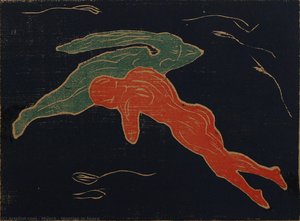
Acrylic On Canvas.

§ 1Catalogue data

§ 2Abstract
Beskrivelse af samlerobjektet
 Vis mere
Kunstnerbiografi
Edvard Munch (1863-1944): En norsk maler kendt for 'Skriget' og sin ekspressive skildring af angst, sorg og menneskets skrøbelighed. Se hans ikoniske værker!
§ 3Commentary
Night in St. Cloud: A Study in Melancholy and Light
Edvard Munch’s “Night in St. Cloud,” painted in 1890, stands as a cornerstone of Expressionism—a movement that sought to convey inner emotional experience rather than objective reality. This haunting monochrome depiction captures the pervasive gloom of twilight over a tranquil landscape, yet it pulsates with an unsettling tension born from Munch’s deeply personal anxieties.
The painting showcases a simple room interior bathed in diffused light emanating from a window. Two chairs occupy the foreground, positioned strategically to draw the viewer's gaze inwards. Further back are two couches—one on the left and one on the right—creating a sense of spatial depth that reinforces the feeling of isolation. A solitary figure sits near the window, seemingly absorbed in contemplation, mirroring the artist’s own preoccupation with introspection.
Munch employed a technique characterized by loose brushstrokes and subtle gradations of tone – primarily shades of grey – to achieve an atmosphere of palpable sadness. Unlike Impressionists who aimed to capture fleeting moments of visual sensation, Munch prioritized conveying psychological states. The muted palette contributes significantly to the painting’s emotional resonance, mirroring the artist's internal turmoil.
Symbolism and Psychological Depth
“Night in St. Cloud” is laden with symbolic significance reflecting Munch’s preoccupation with themes of mortality and existential dread. The darkened room represents the subconscious mind—a space where fears and anxieties reside unseen. The window symbolizes a connection to the outside world, yet it offers no solace; instead, it illuminates the bleakness within. The solitary figure embodies vulnerability and loneliness – emotions central to Munch’s artistic vision.
The clock hanging on the wall serves as a poignant reminder of time's relentless march toward death—a motif recurrent in Munch’s oeuvre. It underscores the inescapable reality of human suffering and reinforces the painting’s overarching mood of melancholy. The artist himself described this piece as “a picture of my soul,” encapsulating its profound psychological depth.
Historical Context: Expressionism Emerges
Painted during a period marked by intellectual ferment and societal upheaval, "Night in St. Cloud" aligns itself with the burgeoning Expressionist movement. Influenced by Nietzsche’s philosophy and fueled by anxieties surrounding industrialization and urbanization, Expressionists rejected academic conventions in favor of subjective emotional expression.
Munch's work anticipated the broader artistic trends of the early 20th century—a shift away from representational art toward explorations of inner experience. He sought to depict not what he *saw*, but what he *felt*, establishing himself as a pivotal figure in shaping modern art’s preoccupation with psychological realism.
Emotional Impact: A Portrait of Inner Turmoil
"Night in St. Cloud" continues to captivate viewers today due to its ability to evoke profound emotional responses. The painting's subdued colors and unsettling composition convey a sense of unease and melancholy—a testament to Munch’s masterful manipulation of artistic technique to communicate psychological states.
Owning a high-quality reproduction allows you to experience the enduring power of this iconic artwork, transporting you into Munch’s world of anxiety and introspection. Let “Night in St. Cloud” inspire contemplation on themes of solitude, mortality, and the complexities of human emotion—a timeless masterpiece that speaks volumes about the human condition.
Spørgsmål og svar
Hvordan downloader jeg billedet af "Night in St. Cloud" af Edvard Munch?
"Night in St. Cloud" af Edvard Munch kan downloades fra værkets Download-side som et højopløseligt digitalt billeddownload.
Hvem er ophavsmanden til "Night in St. Cloud", og hvilken kunstretning tilhører værket?
Edvard Munch skabte "Night in St. Cloud" inden for Expressionism-bevægelsen.
Bruger "Night in St. Cloud" af Edvard Munch stærke kontraster eller bløde harmonier?
Farveanalysen af "Night in St. Cloud" af Edvard Munch viser en Gentle kontrast og en Softly Mixed Palette harmoni.


 Skift til printsalg


 For kunstværker eller reproduktioner, der er større end 105 cm (ca. 41 tommer) på en hvilken som helst side, vil rammen blive leveret som et adskilt sæt. Denne metode sikrer sikker levering og forhindrer skader under transport.