1912. Akryl på lærred.

§ 1Katalogdata


§ 2Abstrakt
 Vis mere
Kunstnerbiografi
Udforsk Egon Schieles følelsesladede ekspressionistiske kunst – kraftfulde portrætter, psykologiske temaer & unikke linjer. Opdag håndmalte reproduktioner nu!
§ 3Kommentarer
Egon Schiele’s Self Portrait: A Window into Expressionist Angst
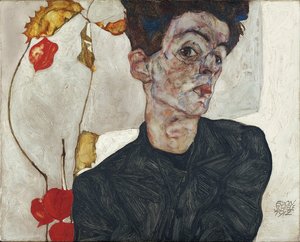
Egon Schiele (1890-1918), an Austrian Expressionist painter, stands as a singular voice within the turbulent landscape of early 20th-century art. His oeuvre is characterized by visceral emotion and unsettling imagery—themes that find their most poignant articulation in “Self Portrait,” completed in 1912. This artwork isn’t merely a depiction of the artist; it's an unflinching exploration of his inner turmoil, reflecting the broader anxieties simmering beneath the surface of European culture at the time.
- Artistic Context: Schiele’s artistic journey was profoundly shaped by Gustav Klimt, whose opulent decorative style—particularly evident in “The Kiss”—established a precedent for bold color palettes and stylized forms. However, Schiele swiftly distanced himself from Klimt's aesthetic, forging his own path marked by jagged lines and deliberate distortions of anatomy. This stylistic rebellion cemented his position as a pivotal figure in the Expressionist movement.
- Technique & Composition: Executed in watercolor on paper, “Self Portrait” exemplifies Schiele’s mastery of medium. The muted tonal range—primarily browns and blacks punctuated by subtle reds and yellows—creates an atmosphere of intense concentration. Minimalistic composition prioritizes the face itself, emphasizing its expressive contours and conveying a palpable sense of psychological depth. Notice how Schiele utilizes negative space to amplify the impact of his subject’s gaze.
- Symbolism & Emotional Depth: The portrait captures Schiele's signature stare—a piercing gaze that seems to penetrate beyond the canvas, inviting contemplation on themes of vulnerability and self-awareness. The slight tilt of the head and the angular positioning of facial features communicate a dynamic emotion – one imbued with unease and introspection. Schiele’s deliberate omission of the thumb is particularly noteworthy; it symbolizes detachment and perhaps an inability to fully grasp oneself.
- Historical Significance: “Self Portrait” embodies the broader artistic impulse of its era, where artists sought to grapple with existential questions and convey subjective experience rather than objective representation. Alongside works by Klimt and Munch, Schiele’s contribution helped propel Expressionism toward its zenith, establishing him as a cornerstone of modern art.
Today, “Self Portrait” continues to resonate powerfully with audiences worldwide. Its raw emotion and innovative stylistic choices serve as an enduring testament to Schiele's artistic legacy. Reproductions offer a captivating glimpse into this seminal artwork—a window into the artist’s psyche and the anxieties of his time.
Further Exploration
- Discover more about Egon Schiele’s life and work: Egon Schiele
- Explore related artworks: Self Portrait as St Sebastian (poster), Self-Portrait by Egon Schiele
- Find inspiration for interior design: Interior Design Inspiration
Spørgsmål og svar
Er farverne i "Selvportræt" kraftige eller dæmpede?
"Selvportræt" af Egon Schiele er gengivet med en Dæmpet farvemætning mætning og en Afbalanceret intensitet.
Hvem har skabt "Selvportræt"?
Kunstneren bag "Selvportræt" er Egon Schiele. Værket er katalogiseret under Egon Schieles navn.
Hvorfor er ophavsretsstatus for "Selvportræt" som den er?
"Selvportræt" af Egon Schiele er i det offentlige domæne – ophavsretten er udløbet. Ophavsretten beregnes ud fra kunstnerens dødsår, og Egon Schiele døde i 1918.


 Skift til printsalg


 For kunstværker eller reproduktioner, der er større end 105 cm (ca. 41 tommer) på en hvilken som helst side, vil rammen blive leveret som et adskilt sæt. Denne metode sikrer sikker levering og forhindrer skader under transport.