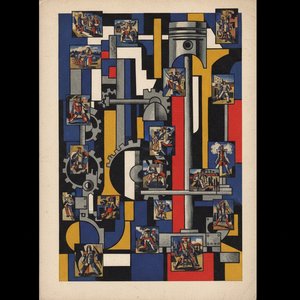
1926. Oil On Canvas.

§ 1Catalogue data


§ 2Abstract
Beskrivelse af samlerobjektet
Fernand Léger’s vibrant accordion painting embodies modernist dynamism, blending bold geometric shapes and striking color palettes—primarily red and yellow—to capture the energy of industrial progress. Explore this iconic piece from 1926 and bring Léger's revolutionary vision home.
 Vis mere
Kunstnerbiografi
Fernand Léger (1881-1955): En pioner indenfor kubisme og 'tubism'! Oplev kraftfulde malerier, der fejrer moderne liv, maskiner og menneskekroppen – en nøgleskaber for Pop Art.
§ 3Commentary
A Symphony of Industrial Rhythm
In the vibrant landscape of early twentieth-century modernism, few works capture the pulse of the machine age as electrifyingly as Fernand Léger’s 1926 masterpiece, The Accordion. This is not merely a painting of a musical instrument; it is a bold, chromatic manifesto that translates the mechanical heartbeat of urban life onto a static canvas. Upon first encounter, the viewer is swept up in a sea of luminous reds and sun-drenched yellows, anchored by assertive black accents that slice through the composition with architectural precision. Léger rejects the hazy, ephemeral softness of Impressionism, opting instead for a visual language defined by structural integrity and a profound clarity that demands attention.
The centerpiece of this rhythmic dance is the accordion itself—a symbol that bridges the gap between soulful human expression and the burgeoning mechanical power of the era. Through his unique lens, Léger presents the instrument not as a static object of nostalgia, but as an active participant in a larger, geometric choreography. The composition is a masterful display of Constructivism, where the world is reimagined through simplified forms such as cylinders, cubes, and intersecting planes. As the eye wanders across the canvas, one discovers smaller, fragmented echoes of the accordion scattered throughout the periphery, creating a sense of infinite movement that mirrors the relentless energy of a modernizing Europe.
The Art of the Machine Age
To understand The Accordion is to understand the soul of the post-World War I era, a period defined by unprecedented urbanization and the rapid expansion of industrial technology. Léger, whose early life was rooted in the physical labor of rural Normandy, found a profound connection between the rhythmic movements of manual work and the precision of the machine. His technique utilizes tachisme—a method of applying paint with loose, gestural strokes—to infuse his rigid geometric shapes with a sense of organic vitality. This tension between the structured, mechanical forms and the energetic, painterly texture creates a captivating visual friction that keeps the viewer perpetually engaged.
For the discerning collector or interior designer, this artwork offers more than just aesthetic beauty; it provides a sophisticated focal point that embodies strength and dynamism. The painting’s ability to command a room lies in its balanced use of primary colors and bold outlines, making it an ideal centerpiece for contemporary spaces that celebrate modernism and structural elegance. Owning a high-quality reproduction of this work allows one to invite the spirit of the avant-garde into their home, serving as a constant reminder of a time when art dared to embrace the beautiful, clanging complexity of the modern world.
Spørgsmål og svar
Hvilken atmosfære formidler "The accordion"?
Den overordnede stemning i "The accordion" af Fernand Léger er Bold. Stemningen beskriver værkets generelle atmosfære.
Hvorfor er ophavsretsstatus for "The accordion" som den er?
"The accordion" af Fernand Léger er i det offentlige domæne – ophavsretten er udløbet. Ophavsretten løber fra kunstnerens dødsår, som var 1955.
Er billedet af "The accordion" af Fernand Léger frit tilgængeligt i det offentlige domæne?
"The accordion" af Fernand Léger er i det offentlige domæne – ophavsretten er udløbet. Denne status bestemmer, hvordan billedet af værket må reproduceres.


 Skift til printsalg


 For kunstværker eller reproduktioner, der er større end 105 cm (ca. 41 tommer) på en hvilken som helst side, vil rammen blive leveret som et adskilt sæt. Denne metode sikrer sikker levering og forhindrer skader under transport.