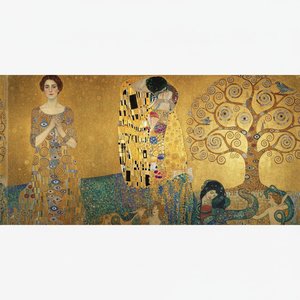
1901. Acrylic On Canvas, 84.0 x 42.0 cm.

§ 1Catalogue data

- 84.0 x 42.0 cm


§ 2Abstract
Beskrivelse af samlerobjektet
 Vis mere
Kunstnerbiografi
Gustav Klimt (1862-1918) var en østrigsk maler kendt for sin dekadente stil, 'guldalderen' og symbolistiske portrætter. Han var central i Wien Secession og udforskede kærlighed, død og skønhed med et unikt udtryk.
§ 3Commentary
Judith and Holopherne
Gustav Klimt's Judith and Holopherne is a striking oil painting created in 1901, showcasing the artist's unique blend of symbolism and sensuality. This piece is part of Klimt's Golden Phase, characterized by its use of gold leaf and intricate patterns.The Artistic Context
Klimt’s interpretation of Judith, the biblical heroine who beheaded General Holofernes to save her city from destruction, diverges from traditional depictions. Unlike other artists who emphasized Judith’s heroic nature, Klimt focuses solely on the figure of Judith, omitting any narrative context. The painting is devoid of an ensanguined sword, suggesting that Judith might have used a different weapon, which aligns with the association with Salome.Symbolism and Sensuality
The painting exudes sensuality, with Judith’s exposed breasts being the central focus. Her gaze is directed downward, possibly at the severed head of Holofernes, which is partially cut off at the bottom right corner of the canvas. This deliberate omission by Klimt adds to the enigmatic nature of the piece. The artist's masterful use of gold leaf amplifies this sensual element, creating a shimmering surface that draws the eye and evokes feelings of opulent beauty.Artistic Influences
Klimt’s work was influenced by various artists and styles. For instance, his use of gold leaf and symbolic motifs can be traced back to Byzantine mosaics. The sensual depiction of Judith is reminiscent of ancient Greek and Roman art, where female figures were often portrayed in a state of undress. Klimt's meticulous attention to detail—the folds of Judith’s robe, the subtle shading—demonstrates his command of academic technique while simultaneously pushing boundaries into expressive abstraction.Relevance and Legacy
Judith and Holopherne is housed at the Österreichische Galerie Belvedere in Vienna, Austria. This painting, along with Klimt's other works, has contributed significantly to the Art Nouveau movement. His unique style and thematic explorations have inspired generations of artists. The enduring fascination with this artwork stems from its ability to capture both psychological complexity and visual splendor—a testament to Klimt’s genius as a painter and his profound understanding of human emotion.- Gustav Klimt: Judith and Holopherne
- Gustav Klimt: Judith I, oil on canvas, Österreichische Galerie
- Gustav Klimt: Judith01
Spørgsmål og svar
Hvornår blev "Judith and Holopherne" skabt, og hvilken stilart tilhører det?
"Judith and Holopherne" blev skabt i 1901 som en del af Golden Phase-bevægelsen.
Hvilken stemning og hvilke følelser udtrykker "Judith and Holopherne" af Gustav Klimt?
Stemningen i "Judith and Holopherne" af Gustav Klimt er Romantic, og dens følelsesmæssige tone er Mysterious.
Hvordan forenes kunstretning og epoke i "Judith and Holopherne" af Gustav Klimt?
"Judith and Holopherne" tilhører Golden Phase-retningen, og dets skaber arbejdede i det 19. århundrede-æraen.


 Skift til printsalg


 For kunstværker eller reproduktioner, der er større end 105 cm (ca. 41 tommer) på en hvilken som helst side, vil rammen blive leveret som et adskilt sæt. Denne metode sikrer sikker levering og forhindrer skader under transport.