


 Se i rummet
 Del som kort
 Del
Del
 Detaljer
 Guide
Guide

 Download
 Lignende værker
 Røntgenundersøgelse
 Diasshow
 Q&A
Q&A Statistikker
Bathing Posts

 Vis mere
Giclée / Kunsttryk
Giclée- eller lærredstryk i museumskvalitet med hurtig produktion og fleksible muligheder for finish. ( Køb håndmalet maleri Skift til digitalt billede)




P118B Dkr10

P118H Dkr10

P118W Dkr10

P438Z Dkr10

P508JH Dkr12

P508YH Dkr12

P805H Dkr10

P805Z Dkr10

P919BZ Dkr10

P919G Dkr10

P919XJ Dkr10

P959ZH Dkr10

P968JZ Dkr12

W106C Dkr8

W218G Dkr10

W218JH Dkr8

W218Y Dkr10

W307PJ Dkr10

W316G Dkr10

W316PJ Dkr8

W316Y Dkr10

W398PJ Dkr8

W4111J Dkr10

W500HY Dkr15

W500JH Dkr15

W692G Dkr12

W849H Dkr8

W940BG Dkr15

W953PJ Dkr8




Vælg mellem vores forudindstillede størrelser, der matcher kunstværkets originale proportioner.

Indtast den bredde og højde, du har brug for, så det passer til din ramme eller din væg. Et print kan kun beskæres, aldrig gøres større end selve billedet, så en størrelse med et andet format vil medføre, at dele af motivet går tabt. Vi sender dig en digital mockup til godkendelse, før vi printer noget. Billedet vist på denne side viser ikke den faktiske beskæring — det er kun mockuppen, der gør.
Verdensomspændende levering () på 2 uger i stedet for de sædvanlige 4/5 uger. (30 oktober)

Gratis ekspresforsendelse til hele verden

Lærred af linned i høj kvalitet

Fuld transportforsikring

Garanti for refusion af told og importafgifter

Garanti for præcis farvegengivelse

100 dages returret ved fabrikationsfejl

100% fuld returret

Mængderabat ved flere køb
 Glasmulighed er kun tilgængelig i størrelser under 110 cm

Bathing Posts
Giclée / Kunsttryk
Størrelse på reproduktion
-


Samlet pris
Dkr 428
James Abbott McNeill Whistler’s Bathing Posts: A Study in Atmospheric Impressionism
James Abbott McNeill Whistler (1834–1903), a figure perpetually at odds with convention—a painter who championed “art for art’s sake” during an era obsessed with moralizing narratives—stood apart from his contemporaries. His artistic philosophy, rooted in Aestheticism, prioritized beauty and sensation above didactic purpose, reflecting the broader cultural currents of Victorian Britain. Whistler's journey began in Lowell, Massachusetts, where he absorbed influences from diverse environments fostered by his father’s railroad engineering career, shaping him into an adaptable observer of the world. Despite a brief, disappointing foray into military life at West Point—a path ill-suited to his artistic temperament—Whistler persevered with work for the U.S. Coast and Geodetic Survey, experiences that honed his observational skills without extinguishing his unwavering passion for painting. These formative years instilled within him an innate talent for drawing and a resolute determination to establish himself as a professional artist, embarking on a transatlantic voyage that would immerse him in the vibrant landscape of European artistic innovation. The genesis of Whistler’s rebellious spirit lay in his early exposure to Impressionist ideas, particularly those championed by Claude Monet and Eugène Boudin—artists who prioritized capturing fleeting moments of light and color rather than meticulously depicting subjects with photographic accuracy.- Subject Matter: Whistler's “Bathing Posts,” completed in 1893, depicts a tranquil seaside scene featuring several boats gently bobbing on the surface of Brittany’s ocean waters. The composition is deliberately understated, focusing on capturing the subtle nuances of atmospheric conditions rather than grand narratives.
- Style: Whistler's approach aligns perfectly with Impressionism, yet distinguishes itself through a characteristic “decorative impressionism.” He eschewed the striving for realism favored by many of his peers, opting instead to distill the essence of the scene into harmonious color combinations and textured brushstrokes—a technique that prioritizes visual pleasure over intellectual analysis.
- Technique: Executed on wood panel using oil paint, Whistler employed a layering process known as glazing – applying thin translucent washes of pigment over previous layers to build up depth and luminosity. This meticulous method ensured that the painting radiated warmth and glow, mirroring the ethereal quality of twilight.
Historical Context: Aestheticism and Whistler’s Artistic Vision
Whistler's artistic endeavors flourished during the height of Aestheticism—a movement advocating for art as an end in itself, divorced from moral or social considerations. Influenced by philosophers like Friedrich Nietzsche and Walter Pater, Whistler believed that beauty should be pursued solely for its intrinsic value, rejecting the Victorian preoccupation with didactic storytelling. This conviction fueled his unwavering commitment to artistic experimentation and challenged prevailing artistic conventions—a stance that cemented his reputation as a visionary artist ahead of his time.- Symbolism: While seemingly simple in appearance, “Bathing Posts” carries subtle symbolic resonance. The muted blues and whites evoke feelings of serenity and contemplation, mirroring Whistler’s desire to elevate the viewer's experience beyond mere visual perception.
- Emotional Impact: Whistler aimed to elicit a profound emotional response from his audience—a sensation akin to “musical silence.” He sought to capture not just what he saw but how it *felt*, conveying the quiet beauty of twilight and the contemplative mood of seaside contemplation.
Connections to Other Artists: Whistler’s Influence on Impressionism
Whistler's artistic principles resonated deeply with fellow Impressionists like Frederick Carl Frieseke, Theodore Earl Butler, and Eugène Boudin. His emphasis on color harmony and atmospheric perspective served as an inspiration for artists striving to capture the fleeting beauty of nature—a legacy that continues to inspire contemporary painters today.Spørgsmål og svar
Hvor kan jeg købe et print af "Bathing Posts" af James Abbott McNeill Whistler?
"Bathing Posts" er tilgængelig som et fine art-print på bomuldscanvas eller arkivbestandigt lærredspapir. Du kan bestille den i den ønskede størrelse på dens Kunstprint i høj kvalitet-side.
Hvordan er farvesammensætningen i "Bathing Posts" af James Abbott McNeill Whistler opbygget?
Farveanalysen af "Bathing Posts" af James Abbott McNeill Whistler viser en Balanced kontrast og en Discordant Palette harmoni.
Hvor meget lys ser farverne i "Bathing Posts" ud til at reflektere?
Farverne i "Bathing Posts" har en Bright Balance luminans.
Lignende kunstværker


Kunstnerbiografi
James Abbott McNeill Whistler: En Pionerers Kamp for Kunstens Frihed
James Abbott McNeill Whistler, født i Lowell, Massachusetts i 1834, var en kunstner der konstant stod over for konventionerne – en maler der kæmpede for “kunst for kunstens skyld” i en æra, hvor moralisering blev betragtet som kunstens primære formål. Hans tidlige liv, præget af hyppige flytninger på grund af hans fars arbejde som jernbaningeniør, indgydte ham en følelse af tilpasningsevne og eksponering for forskellige miljøer. Et kort, ulykkeligt forsøg på at studere ved West Point, efterfulgt af arbejde med den amerikanske kyst- og geodetiske undersøgelse – selvom det forsinkede hans kunstneriske udvikling – slukte ikke hans brændende passion for kunst. Disse formative år var kendetegnet af en naturlig talent for tegning og et bestemt ønske om at skabe en karriere som professionel kunstner, en stræben der i sidste ende førte ham over Atlanten og ind i hjertet af den europæiske avantgarde. Frøene til Whistlers kunstneriske oprør blev sået tidligt, næret af et åndedræt, der modstod konformitet og omfavnede æstetisk udforskning frem for alt andet.Paris’s Indflydelse: Fra Realisme til Æstetisk Eksperimentering
Det afgørende øjeblik i Whistlers kunstneriske rejse kom med hans flytning til Paris i 1855. Her, under vejledning af Sébastien Bouré, forfinede han sine færdigheder inden for oliemaleri, vandfarve og trykning, absorberede indflydelserne fra fransk realisme og Barbizon-malerne. Whistler overgik hurtigt blot imitation; han søgte at fange *essensen* af tingene – deres flygtige stemninger og subtile nuancer. Han var ikke interesseret i at gengive virkeligheden nøjagtigt, men snarere i at skabe et kunstværk, der udtrykte den atmosfære og følelse, han oplevede. Denne periode markerede en afgørende forandring fra repræsentationsnøjagtighed mod en udforskning af ren æstetisk form. Hans tidlige værker antydede allerede den delikate balance mellem observation og abstraktion, der skulle definere hans modne stil. Det var i Paris, at Whistler begyndte at argumentere for, at kunstens værdi kun kunne måles ud fra dens æstetiske kvalitet – fri for moralske eller sociale kommentarer. Denne filosofi blev hjørnestenen i hans kunstneriske praksis og en afgørende faktor i den æstetiske bevægelse.Tonalisme og Atmosfære: En Ny Form for Maleri
Whistlers unikke stil var præget af tonal harmonier og atmosfæriske effekter, hvilket adskilte ham fra mange af hans samtidige. Han eksperimenterede med begrænsede farvepaletter og lette penselstrøg for at skabe en følelse af æterisk skønhed og ro. Hans malerier var ofte studier i lys og skygge, der forsøgte at fange øjeblikket – den flygtige stemning i et rum eller en scene. Dette er tydeligt synligt i hans mest berømte værk, *Arrangement in Grey and Black No. 1 (Whistler’s Mother)*, hvor han transformerer et portræt af sin mor til et ikonisk symbol på moderlighed gennem sin omhyggelige brug af form og tone. Han var inspireret af den japanske kunst – især ukiyo-e-tryk – som informerede hans kompositionsprincipper og hans fokus på dekorative mønstre.Kontroversen og Whistlers Kamp for Frihed
Whistlers karriere var ikke uden kontroverser. Den berømte retssag mod ham i 1878, anlagt af kritikeren John Ruskin, blev udløst af *Nocturne in Black and Gold – The Falling Rocket*. Whistler argumenterede overbevisende for, at hans malerier ikke var ment som realistiske gengivelser, men snarere æstetiske arrangementer af farve og form. Denne sag hævede hans profil og udløste vigtige debatter om kunstens natur og den kunstneriske friheds værdi. Selvom han vandt sagen, blev Whistlers kamp for at definere kunstens rolle som en uafhængig disciplin et symbol på den æstetiske bevægelses stræben efter at frigøre kunsten fra traditionelle moralske og didaktiske begrænsninger.Et Eftermæle af Æstetik
James Abbott McNeill Whistler døde i London i 1903, men hans kunstneriske arv lever videre. Han er husket som en pioner, der kæmpede for kunstens frihed og udforskede de æstetiske muligheder for farve og form. Hans værker fortsætter med at fascinere og inspirere kunstnere verden over, og hans bidrag til den moderne kunsthistorie er uomtvisteligt.- Bemærkelsesværdige værker: *The Forge* (1861), *Portrait of Charles Lang Freer* (1873), *Brown and Gold: The Gold Girl—Connie Gilchrist* (1876-77), *Arrangement in Grey and Black No. 1 (Whistler’s Mother)* (1871), *Nocturne in Black and Gold – The Falling Rocket* (1875).
- Indflydelser: Japansk kunst, Velázquez.
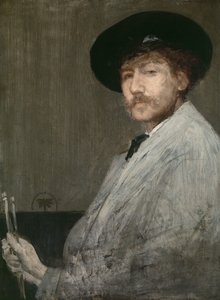
James Abbott McNeill Whistler
1834 - 1903 , USA
Kort om kunstneren
- Artistic Movement Or Style: Estetisk og tonalist
- Artists Or Movements Influenced By This Artist: ['Estetisk bevægelse']
- Artists Who Influenced This Artist:
- Velázquez
- Japan
- Date Of Birth: 14. juli 1834
- Date Of Death: 17. juli 1903
- Full Name: James Abbott McNeill Whistler
- Nationality: Amerikansk
- Notable Artworks:
- Moderen
- Natscene
- Place Of Birth: Lowell, USA
Relaterede artikler

The Allure of Azure: Exploring the Symbolic & Aesthetic Depths of Blue in Art History
Explore the rich history of blue in art! Discover its symbolism, from ancient pigments to modern masterpieces by Kandinsky & Seurat. Uncover the psychological impact and cultural meanings behind this captivating hue.

Serene Blue Backgrounds: Discover Soulful Art to Transform Your Space with Timeless Elegance
Transform your home with soulful blue art. From serene Monet impressions to modern textured sculptures, discover curated masterpieces designed to inspire calm. Explore expert art consultations and bespoke hand-painted reproductions to create your personal sanctuary.
Top 10 Berømte Malerier i Skønne Slate Blue Nuancer – Kunst til Dit Hjem
Oplev skønheden i 10 berømte malerier domineret af den elegante slate blue nuance. Fra Monet til Van Gogh – lær historierne bag ikoniske kunstværker og find inspiration til dit hjem. Køb museumskvalitets reproduktioner på AllPaintingsStore.com

The Allure of the Horizon: A Comprehensive Exploration of Seascape Art Through History & Emotion
Explore the captivating world of seascape art! Discover its history, key artists & movements – from Dutch Masters to Impressionism. Expert insights for collectors and enthusiasts at AllPaintingsStore.
James Abbott McNeill Whistler: Top 25 Kunstværker – Skønhed, Harmoni & Historie | AllPaintingsStore
Oplev James Abbott McNeill Whistlers 25 mest ikoniske kunstværker. Fordyb dig i æstetismens verden, tonale malerier & harmoniske kompositioner. Find reproduktioner af højeste kvalitet og inspiration til din indretning på AllPaintingsStore.com.


